
If your salary arrives at the beginning of the month but you are often left wondering where the money went, the problem may not be how much you earn. The problem may be that your money does not have a clear plan.
Zero-based budgeting is a simple way to solve this.
Learning how to make a zero based budget means deciding what every rupee should do before you spend it. You plan for essentials, lifestyle expenses, savings, investments, debt payments, and even small personal expenses.
At the end of the budgeting process:
Income − Expenses − Savings − Investments = ₹0
This does not mean you should spend your entire salary.
It means every rupee has been assigned a purpose.
Here is a step-by-step guide to creating your first zero-based budget.
Table of Contents
What Is a Zero-Based Budget?
A zero-based budget is a budgeting method in which you assign your entire monthly income to specific categories.
Suppose your monthly take-home income is ₹40,000.
Instead of spending throughout the month and saving whatever remains, you decide in advance how the ₹40,000 will be used.
For example:
- Rent: ₹10,000
- Groceries: ₹5,000
- Utilities: ₹2,500
- Transport: ₹3,000
- Insurance: ₹1,500
- Personal expenses: ₹3,000
- Entertainment: ₹1,500
- Emergency fund: ₹4,000
- Investments: ₹5,000
- Other planned expenses: ₹4,500
Total = ₹40,000
Your remaining unassigned amount is ₹0.
Again, this does not mean your bank balance needs to become zero. The money allocated to your emergency fund and investments is still yours. It simply has a defined purpose.

Why Zero-Based Budgeting Can Be Useful
Many people follow an informal budgeting system.
They pay their bills, spend money during the month, and hope something remains for savings.
Zero-based budgeting reverses this process.
Instead of asking:
“How much money is left?”
you ask:
“What should this money do?”
This can help you become more intentional about spending.
A zero-based budget may help you:
- Understand exactly where your income is going
- Reduce unnecessary spending
- Prioritise savings
- Prepare for irregular expenses
- Set money aside for financial goals
- Identify expenses that can be reduced
- Avoid depending entirely on leftover money for savings
The method can be particularly useful for beginners who want a structured monthly money-management system.

How to Make a Zero Based Budget Step by Step
You do not need complicated financial software to begin.
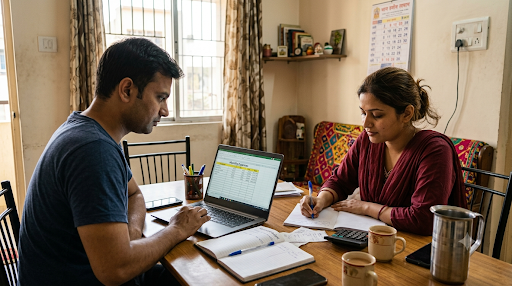
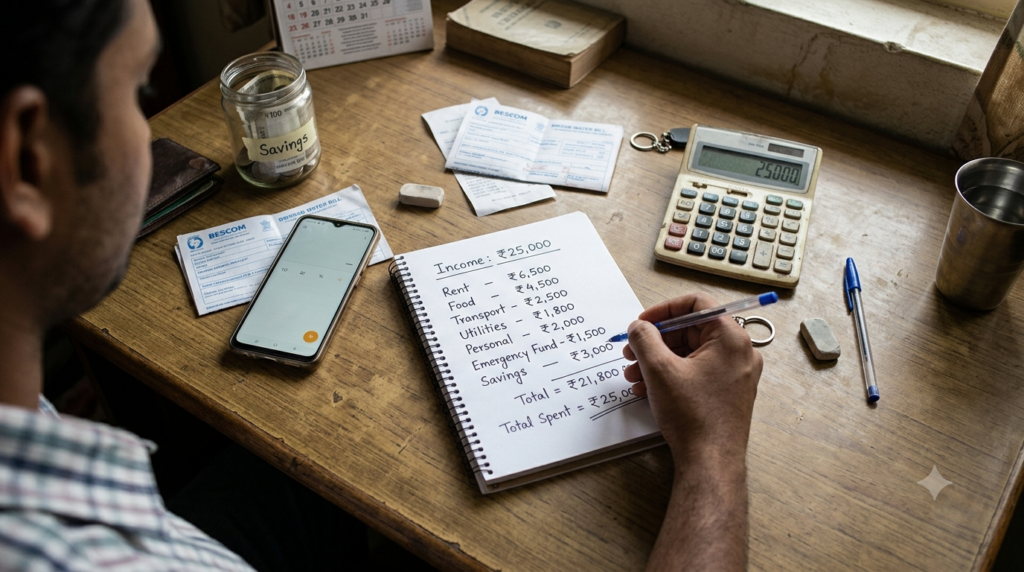
A notebook, spreadsheet, budgeting app, or simple monthly budget table can work.
The important part is assigning your income deliberately.

Step 1: Calculate Your Monthly Take-Home Income
Start with the money you actually expect to receive during the month.
For a salaried employee, this may simply be the salary credited to the bank account after deductions.
For example:
Monthly take-home salary: ₹40,000
If you have additional predictable income, you can include it.
For example:
Salary: ₹40,000
Freelance income: ₹5,000
Total monthly income: ₹45,000
If your side income varies significantly, consider using a conservative estimate rather than assuming you will receive your best month’s income every month.
Your budget should preferably be based on money you can reasonably expect to receive.
Step 2: List Your Essential Fixed Expenses
Next, identify expenses that are relatively predictable every month.
These may include:
- Rent
- Home loan EMI
- Education fees
- Insurance premiums
- Loan EMIs
- Internet
- Mobile bills
- Regular subscriptions
Suppose you earn ₹40,000.
Your fixed expenses could look like this:
Rent: ₹10,000
Internet and mobile: ₹1,000
Insurance: ₹1,500
EMI: ₹3,000
Total fixed expenses: ₹15,500
These expenses usually receive priority because many of them are difficult to change immediately.
Step 3: Estimate Your Variable Essential Expenses
Some necessary expenses change from month to month.
Common examples include:
- Groceries
- Electricity
- Fuel
- Public transport
- Medicines
- Household supplies
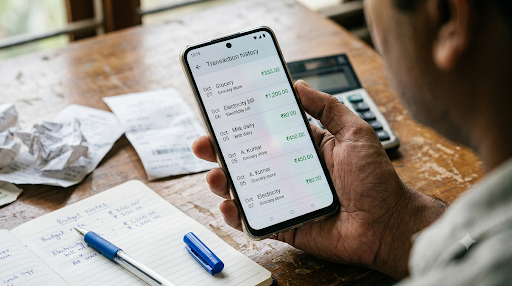
Look at previous bank statements, UPI transactions, credit-card statements, or receipts to estimate realistic amounts.
For example:
Groceries: ₹5,000
Electricity and utilities: ₹1,500
Transport: ₹3,000
Household essentials: ₹1,500
Total variable essentials: ₹11,000
Avoid setting unrealistically low limits just to make the budget look good.
A useful budget should reflect your actual life.

Step 4: Add Savings as a Budget Category
One of the most important changes you can make is treating savings as something you plan—not merely whatever happens to remain at the end of the month.
Your savings categories could include:
- Emergency fund
- Short-term savings
- Future purchases
- Investment contributions
- Retirement goals
For example:
Emergency fund: ₹3,000
Investments: ₹3,000
Total savings and investments: ₹6,000
By including these amounts directly in the budget, you give financial goals a defined place alongside monthly expenses.

Step 5: Plan for Irregular Expenses
This is one of the easiest budgeting categories to forget.
Not every expense occurs every month.
Examples include:
- Vehicle servicing
- Annual insurance premiums
- Festivals
- Gifts
- School expenses
- Repairs
- Clothing
- Travel
- Medical expenses
- Annual subscriptions
Suppose you expect vehicle maintenance of approximately ₹6,000 six months from now.
Instead of suddenly finding ₹6,000 in that month, you could allocate ₹1,000 per month for six months.
This is sometimes called a sinking fund.
The principle is simple:
Expected future expense ÷ Number of months remaining = Monthly amount to save
Planning for predictable irregular expenses can make your monthly budget more stable.
Step 6: Create a Personal-Spending Category
A budget that allows nothing for enjoyment can be difficult to maintain.
Depending on your income and priorities, you might allocate money for:
- Eating out
- Movies
- Shopping
- Hobbies
- Entertainment
- Personal care
Suppose you allocate:
Eating out: ₹1,500
Entertainment: ₹500
Personal spending: ₹1,000
Total: ₹3,000
Having a defined amount gives you room to enjoy your money without allowing discretionary spending to take over the entire budget.

Step 7: Subtract Everything From Your Income
Now calculate:
Income − Planned expenses − Savings − Investments
Suppose your monthly income is ₹40,000 and you have currently allocated ₹37,500.
₹40,000 − ₹37,500 = ₹2,500
You still have ₹2,500 without a job.
Under zero-based budgeting, you now decide where that ₹2,500 should go.
You might allocate it to:
- Emergency savings
- Debt repayment
- Investments
- A future purchase
- Travel savings
- Another financial goal
Once that ₹2,500 is assigned, the budget reaches zero.
Step 8: Adjust the Budget Until the Balance Is Zero
What if your planned expenses total more than your income?
For example:
Income: ₹40,000
Planned allocation: ₹43,000
You have a ₹3,000 shortfall.
This is where zero-based budgeting becomes useful because it forces you to confront the gap before spending the money.
Review flexible categories first.
Could you reduce:
- Dining out?
- Shopping?
- Entertainment?
- Subscriptions?
- Optional purchases?
If essential expenses are consuming most of your income, the solution may require larger changes over time, such as reducing housing or transport costs, restructuring financial goals, or increasing income.
The goal is to create a budget based on the money you actually have—not the money you wish you had.
Zero-Based Budget Example for a ₹40,000 Salary
Here is a simple example.
Monthly Income: ₹40,000
Rent — ₹10,000
Groceries — ₹5,000
Utilities — ₹2,000
Transport — ₹3,000
Insurance — ₹1,500
EMI — ₹3,000
Emergency Fund — ₹3,000
Investments — ₹4,000
Sinking Funds — ₹2,000
Personal Spending — ₹2,000
Entertainment — ₹1,000
Miscellaneous — ₹3,500
Total Allocated: ₹40,000
Amount Left Unassigned: ₹0
Every rupee now has a planned purpose.
Notice that ₹9,000 in this example goes toward the emergency fund, investments, and sinking funds. Reaching zero therefore does not mean spending ₹40,000 on consumption.
It means allocating the complete ₹40,000.
What If Your Income Changes Every Month?
Zero-based budgeting can also be adapted for irregular income.
Suppose you are a freelancer and your monthly income varies.
Instead of building your lifestyle around your highest-income month, identify your essential expenses and financial priorities first.
A possible priority order could be:
- Housing
- Food
- Utilities
- Transport
- Essential debt obligations
- Insurance
- Emergency savings
- Other savings and investments
- Discretionary spending
During a higher-income month, additional money could be directed toward emergency savings, future expenses, debt repayment, or other goals rather than automatically increasing lifestyle spending.
Because individual circumstances differ, the exact priority order should match your obligations and financial situation.
Common Zero-Based Budgeting Mistakes
1. Forgetting Small Expenses
Tea, snacks, delivery fees, app purchases, and small UPI transactions can add up.
Include a realistic miscellaneous category instead of pretending these expenses will never happen.
2. Making the Budget Too Restrictive
If you normally spend ₹4,000 on discretionary expenses, suddenly limiting yourself to ₹500 may not be sustainable.
Gradual reductions may be easier to maintain.
3. Forgetting Annual Expenses
Insurance renewals, repairs, festivals, travel, and other irregular expenses can disrupt a monthly budget.
Create sinking funds for predictable future costs.
4. Treating Zero as Permission to Spend Everything
The objective is not to empty your bank account.
Savings and investments should also receive allocations.
5. Never Reviewing the Budget
Your first zero-based budget probably will not be perfect.
Actual expenses may differ from estimates.
Reviewing the budget allows you to improve it.
How to Track Your Zero-Based Budget During the Month
Creating a budget is only the first step.
You also need to compare your plan with your actual spending.
You can use:
- A spreadsheet
- A budgeting app
- A notebook
- Bank transaction history
- UPI transaction records
Suppose you budgeted ₹5,000 for groceries but spent ₹5,800.
You are ₹800 over budget.
Instead of ignoring it, adjust another flexible category by ₹800 if possible.
For example, you might reduce entertainment spending from ₹1,500 to ₹700.
The overall budget remains balanced.
Should You Create a New Zero-Based Budget Every Month?
Ideally, review your budget every month because expenses and priorities change.
One month may include:
- A festival
- Vehicle servicing
- School fees
- Travel
- Insurance renewal
Another month may not.
Your basic categories can remain similar, but the amounts can change.
This is why zero-based budgeting is better viewed as an active monthly plan rather than a budget you create once and forget.
Zero-Based Budget vs 50/30/20 Rule
The two methods approach budgeting differently.
The 50/30/20 rule generally divides income into broad categories such as needs, wants, and savings.
Zero-based budgeting is more detailed.
Every rupee receives a specific purpose.
The 50/30/20 method may suit someone who wants a simpler framework.
Zero-based budgeting may suit someone who wants more control over individual categories.
Neither method automatically guarantees better financial results. The useful method is the one you can realistically follow and review consistently.
A Simple Zero-Based Budget Formula
You can remember the system with one formula:
Monthly Income − Expenses − Savings − Investments = ₹0
Start with income.
Subtract essential expenses.
Subtract discretionary expenses.
Allocate money to savings, investments, and future expenses.
Then keep adjusting until no money remains unassigned.
Final Thoughts
Learning how to make a zero based budget is less about complicated mathematics and more about intentional decision-making.
You calculate your available income, list your expenses, plan for future costs, allocate money toward savings and investments, and give the remaining money a purpose.
The most important idea is simple:
Do not wait until the end of the month to decide what happened to your money. Decide at the beginning of the month what you want your money to do.
Your first budget does not need to be perfect.
Track your spending, review the numbers, adjust unrealistic categories, and improve the plan month by month.
Over time, a zero-based budget can give you a clearer picture of where your money goes and whether your spending matches your financial priorities.
Disclaimer: This article is for general educational and informational purposes only. It is not personalised financial, investment, tax, or legal advice. Budgeting decisions should be based on your individual income, expenses, obligations, goals, and circumstances.
Frequently Asked Questions
1. How do you make a zero-based budget?
Start by calculating your monthly take-home income. List your fixed and variable expenses, savings, investments, debt payments, and future expenses. Assign your entire income across these categories until your income minus all planned allocations equals zero.
2. What does zero mean in a zero-based budget?
Zero does not mean spending all your money or having ₹0 in your bank account. It means every rupee of income has been assigned a purpose, including money allocated to savings, investments, and future expenses.
3. What is an example of a zero-based budget?
If your monthly income is ₹40,000, you could allocate the entire ₹40,000 among rent, groceries, utilities, transport, insurance, savings, investments, personal spending, and other planned categories. When the total allocation equals ₹40,000, the amount left unassigned is zero.
4. Is zero-based budgeting good for beginners?
It can be useful for beginners because it provides a clear picture of where money is expected to go. However, it requires regular tracking and monthly adjustments, so some people may prefer a simpler budgeting method.
5. Can I use zero-based budgeting with an irregular income?
Yes. If your income changes each month, prioritise essential expenses and use a conservative income estimate where practical. In higher-income months, additional money can be allocated toward savings, future expenses, debt repayment, investments, or other financial goals.
6. Do I need a budgeting app for zero-based budgeting?
No. You can create a zero-based budget using a notebook, spreadsheet, or budgeting app. The method matters more than the tool you use.