
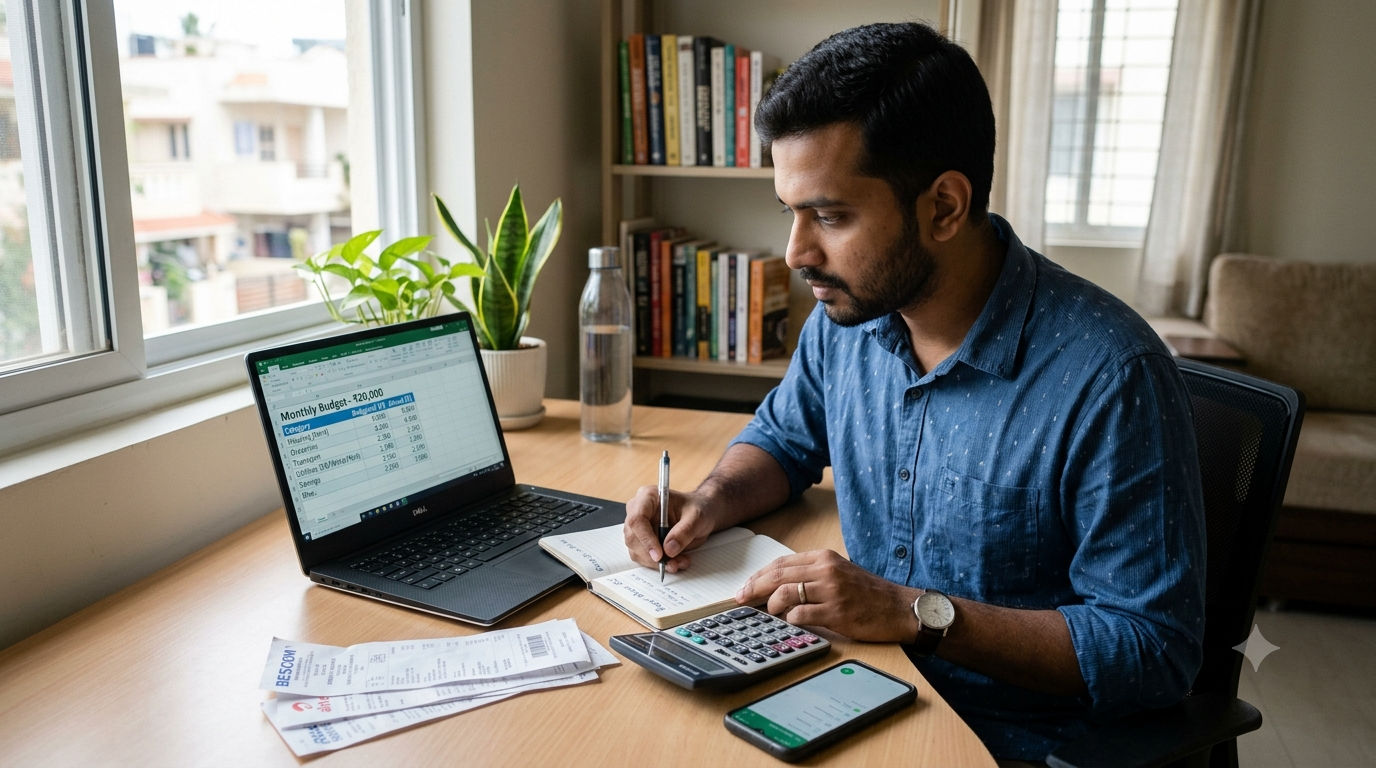
If your salary arrives at the beginning of the month but you often wonder where the money went by the end, a zero-based budget can give you more control.
Zero based budgeting India is a practical budgeting approach in which you give every rupee of your monthly income a purpose. You plan your expenses, savings, investments, debt repayments and other financial goals until:
Income – Planned Allocations = ₹0
The ₹0 does not mean you spend your entire salary.
It means every rupee has been assigned somewhere—including the money you intend to save or invest.
For Indian households managing expenses such as rent, groceries, EMIs, electricity, mobile bills, transportation, insurance, family responsibilities and savings, this approach can make monthly money management much clearer.
Table of Contents
What Is Zero-Based Budgeting?
Zero-based budgeting is a budgeting method where you decide in advance what every rupee of your expected income will do during the month.
Instead of spending first and saving whatever remains, you build the complete plan before the month begins.
For example, imagine your monthly take-home income is ₹50,000.
You might assign it like this:
| Category | Planned Amount |
|---|---|
| Rent | ₹12,000 |
| Groceries | ₹6,000 |
| Utilities & Mobile | ₹3,000 |
| Transport | ₹4,000 |
| EMI/Debt Payments | ₹5,000 |
| Insurance | ₹2,000 |
| Emergency Fund | ₹4,000 |
| Long-Term Savings/Investments | ₹7,000 |
| Personal/Entertainment | ₹3,000 |
| Irregular Expenses Fund | ₹2,000 |
| Buffer | ₹2,000 |
| Total | ₹50,000 |
The result is:
₹50,000 income – ₹50,000 allocated = ₹0
Again, you have not necessarily spent ₹50,000.
For example, ₹4,000 has been allocated to an emergency fund and ₹7,000 to long-term savings or investments. The goal is simply to avoid leaving income without a defined purpose.

Why Zero Based Budgeting India Can Be Useful
A zero-based budget can be especially useful when you know how much you earn but struggle to understand exactly where your money goes.
The Reserve Bank of India’s financial-education material describes a budget as a tool that can help people take control of money and identify areas of unnecessary or excessive spending. It also recommends keeping budgeting simple, reviewing the budget monthly and preparing for unexpected expenses.
That principle fits naturally with zero-based budgeting.
Instead of saying:
“I will try to save more this month.”
You decide:
“₹5,000 of this month’s income is allocated to my emergency fund.”
Instead of:
“I should spend less on eating out.”
You decide:
“My dining-out budget is ₹2,000.”
Specific limits turn vague financial intentions into a monthly plan.
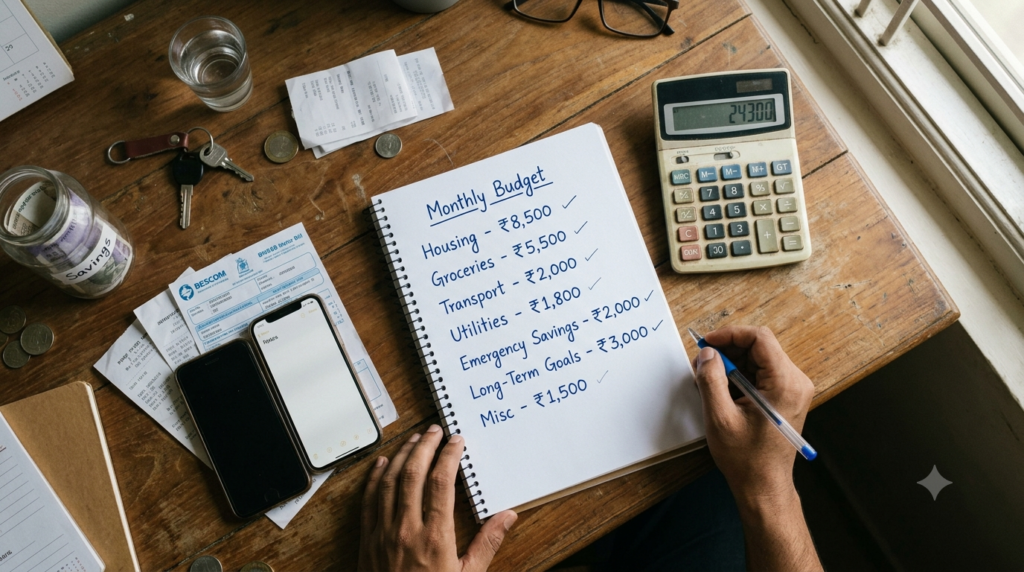
How Zero-Based Budgeting Works
The basic formula is simple:
Monthly Income – Expenses – Savings – Investments – Debt Payments – Other Goals = ₹0
The important word here is planned.
You are not trying to empty your bank account.
You are creating jobs for your money.
Those jobs could include:
- paying rent
- buying groceries
- paying an EMI
- building an emergency fund
- paying insurance premiums
- investing toward long-term goals
- saving for annual expenses
- travelling
- entertainment
- keeping a small buffer
Your savings are therefore part of the budget—not merely whatever survives at the end of the month.

7 Steps to Create a Zero-Based Budget in India
Step 1: Calculate Your Monthly Take-Home Income
Start with the money you actually expect to receive and can budget.
For a salaried employee, this will usually begin with monthly take-home salary rather than CTC.
Depending on your situation, income could also include predictable freelance income, business income, pension, rental income or other regular cash inflows.
Avoid building your essential monthly spending around uncertain income.
If bonuses, incentives or freelance payments vary, you can allocate them separately when they actually arrive.
Step 2: List Your Essential Expenses
Next, write down the expenses that must normally be paid.
These may include:
- rent or home-loan EMI
- groceries
- electricity
- water
- cooking gas
- mobile and internet
- transportation
- school or education expenses
- insurance premiums
- medicines or healthcare
- minimum required debt payments
- essential family responsibilities
Look at previous bank statements, UPI transactions and card statements where available instead of relying entirely on memory.
This gives you a more realistic picture of your normal spending.
Step 3: Identify Variable and Lifestyle Expenses
Now list expenses that can change from month to month.
Examples include:
- restaurants and food delivery
- shopping
- entertainment
- subscriptions
- hobbies
- personal care
- weekend activities
- non-essential travel
These categories are important because they are often easier to adjust than fixed commitments.
The goal is not to eliminate everything enjoyable.
The goal is to decide how much you can comfortably spend on these categories before the spending happens.
Step 4: Give Savings a Job
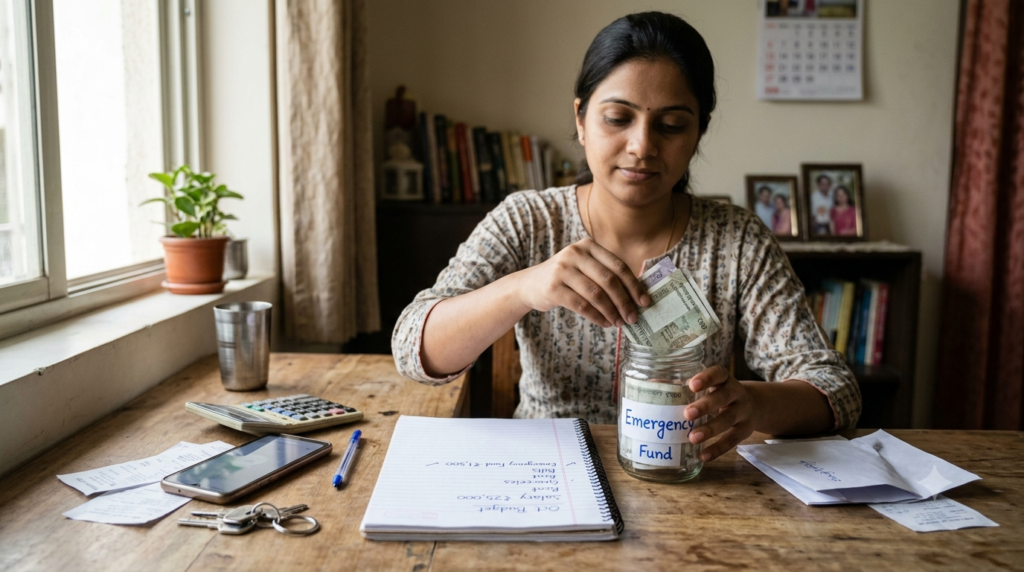
Savings should have a purpose in a zero-based budget.
Instead of creating one vague category called “Savings,” you could separate your money into goals such as:
Emergency fund: Money reserved for unexpected financial shocks.
Annual expenses: Money accumulated gradually for predictable but non-monthly expenses.
Short-term goals: A planned purchase, education expense, trip or other near-term objective.
Long-term goals: Money intended for longer-term financial objectives.
This makes it easier to understand what your savings are actually meant to accomplish.
SEBI’s financial-education material recommends first understanding your current income, expenses, assets and liabilities and then identifying financial goals before implementing and reviewing a financial plan.
Step 5: Plan for Irregular Expenses
One reason monthly budgets fail is that people budget only for expenses that occur every month.
But real life also contains expenses that arrive occasionally.
Examples might include:
- vehicle servicing
- annual insurance premiums
- festivals
- school-related expenses
- home maintenance
- gifts
- planned travel
- appliance repairs
Suppose you expect an expense of ₹12,000 approximately one year from now.
Rather than allowing the full amount to disrupt one month’s budget, you could plan around ₹1,000 per month toward it.
This is sometimes called a sinking fund.
It converts a large future expense into smaller planned monthly allocations.
Step 6: Keep Allocating Until the Balance Reaches Zero
Now subtract every planned allocation from your expected monthly income.
For example:
Income: ₹40,000
Essential expenses: ₹23,000
Lifestyle spending: ₹5,000
Savings/investments: ₹6,000
Debt repayment: ₹3,000
Irregular expenses: ₹2,000
Buffer: ₹1,000
Total allocated: ₹40,000
Money left unassigned: ₹0
If ₹3,000 remains after your first attempt, don’t assume it has to be spent.
Give that ₹3,000 another purpose.
You could allocate it to an emergency fund, a future expense, debt repayment or another financial goal.
Step 7: Track and Review Your Budget Every Month
A budget is a plan—not a prediction.
Your actual spending will rarely match every estimate perfectly.
At the end of the month, compare:
Budgeted Amount vs Actual Amount
Ask:
Where did I overspend?
Which categories were overestimated?
Did any unexpected expense appear?
Was my savings target realistic?
What should I change next month?
RBI financial-education material specifically recommends a monthly review and planning for unexpected “budget busters.”
That is important because a good zero-based budget becomes more accurate with experience.
Zero-Based Budget Example for a ₹30,000 Salary
Here is a purely illustrative example:
| Category | Amount |
|---|---|
| Rent/Shared Accommodation | ₹8,000 |
| Groceries | ₹4,000 |
| Utilities & Mobile | ₹1,500 |
| Transport | ₹2,500 |
| Family/Essential Commitments | ₹3,000 |
| Emergency Fund | ₹2,000 |
| Long-Term Savings/Investments | ₹3,000 |
| Personal Spending | ₹2,000 |
| Irregular Expenses | ₹2,000 |
| Buffer | ₹2,000 |
| Total | ₹30,000 |
₹30,000 – ₹30,000 = ₹0
This is an example, not a recommended universal allocation.
Someone paying high rent in Mumbai or Bengaluru may need a very different budget from someone living with family in a smaller city.
Your budget should reflect your actual income, commitments and goals.
What If Your Expenses Are Higher Than Your Income?
This is where zero-based budgeting can expose an important problem.
Suppose:
Income = ₹35,000
Planned expenses and goals = ₹39,000
You have a ₹4,000 gap.
The budget cannot reach zero without an adjustment.
Review the categories one by one.
Start by separating necessities from wants.
RBI financial-literacy material highlights the distinction between needs and wants, noting that wants can often be postponed.
Look first for discretionary expenses that can realistically be reduced.
If the gap remains after cutting non-essential spending, the issue may be structural—for example, high fixed expenses or debt obligations relative to income. That may require larger changes rather than repeatedly cutting small discretionary purchases.
Zero-Based Budgeting vs the 50/30/20 Rule
Both approaches can help beginners, but they work differently.
| Zero-Based Budget | 50/30/20 Rule |
|---|---|
| Every rupee receives a purpose | Income is divided into broad percentages |
| Highly customizable | Simpler starting framework |
| Requires more tracking | Usually requires less detailed planning |
| Categories can change each month | Uses broad needs/wants/savings buckets |
| Useful for detailed spending control | Useful for people wanting simplicity |
The better method depends on how much detail you want.
If broad spending limits are enough, a percentage-based budget may feel easier.
If you frequently wonder where your money went or want tighter control over specific categories, zero-based budgeting may be more useful.
Common Zero-Based Budgeting Mistakes
Creating an Unrealistically Strict Budget
A budget that leaves nothing for normal personal spending can become difficult to maintain.
Budgeting should be sustainable.
Give yourself reasonable limits instead of assuming you will suddenly eliminate every non-essential expense.
Forgetting Non-Monthly Expenses
Annual premiums, festivals, repairs and similar expenses can make a seemingly perfect monthly budget fail.
Create separate monthly allocations for predictable future expenses.
Treating ₹0 as an Empty Bank Account
This is perhaps the biggest misunderstanding.
A zero-based budget does not mean your bank balance should become zero.
It means:
Income – all planned allocations = zero.
Savings, investments and emergency reserves are themselves allocations.
Making Too Many Categories
Beginners sometimes create dozens of tiny categories and then become tired of tracking them.
Start simple.
You can always add detail later.
Not Adjusting the Budget
If your grocery budget is consistently unrealistic, change it.
If transport costs increase, update them.
If you receive a salary increase, consciously decide how the additional income should be allocated.
A budget should adapt to your financial reality.
A Simple Zero-Based Budget Template
Use this template each month:
MONTHLY INCOME
Salary: ₹_____
Other predictable income: ₹_____
Total Income: ₹_____
ESSENTIAL EXPENSES
Housing: ₹_____
Groceries: ₹_____
Utilities: ₹_____
Transport: ₹_____
Insurance: ₹_____
EMIs/Debt: ₹_____
Family/Education/Healthcare: ₹_____
FINANCIAL GOALS
Emergency Fund: ₹_____
Long-Term Savings/Investments: ₹_____
Short-Term Goal: ₹_____
Irregular Expenses Fund: ₹_____
LIFESTYLE
Eating Out: ₹_____
Entertainment: ₹_____
Shopping: ₹_____
Subscriptions: ₹_____
Other: ₹_____
BUFFER
Miscellaneous/Buffer: ₹_____
TOTAL ALLOCATED: ₹_____
INCOME – TOTAL ALLOCATED = ₹0
If the answer is above zero, assign the remaining money a purpose.
If the answer is below zero, your planned allocations exceed your expected income and need to be adjusted.
How to Make Zero-Based Budgeting Easier
You do not need complicated software.
A notebook can work.
A spreadsheet can work.
A budgeting app can work.
What matters more is maintaining the system consistently.
Try preparing the next month’s budget shortly before the month begins.
Then track major expenses during the month and review the final numbers before preparing the next budget.
After a few months, you should have much better information about your real spending patterns.
Is Zero-Based Budgeting Right for You?
Zero-based budgeting may be particularly useful if:
- you have regular income but struggle to save consistently
- you frequently overspend in specific categories
- you want tighter control over your salary
- you are working toward multiple financial goals
- you have debt repayments to manage
- you want to understand exactly where your money goes
However, someone with highly irregular income may need to modify the method.
In that situation, it can be safer to build the budget around a conservative income estimate or money already received rather than assuming uncertain future earnings.
Final Takeaway
Zero based budgeting India does not require complicated financial calculations.
Its core principle is simple:
Give every rupee a purpose before you spend it.
Start with your take-home income. List essential and discretionary expenses. Allocate money toward savings and financial goals. Prepare for irregular expenses. Keep adjusting the numbers until every rupee has an assigned job.
Then review the plan each month.
You do not need a perfect budget in your first month.
You need a realistic system that helps you understand your money, make deliberate spending decisions and gradually improve how you manage your income.
Frequently Asked Questions
1. What is zero-based budgeting?
Zero-based budgeting is a method where you assign every rupee of your expected income to expenses, savings, investments, debt repayments or other goals until income minus all planned allocations equals zero. It does not mean spending everything or keeping a zero bank balance.
2. Is zero-based budgeting good for beginners in India?
Yes, it can be useful for beginners because it creates a clear plan for salary, bills, savings and discretionary spending. However, the system works best when the budget is realistic and reviewed regularly.
3. Does zero-based budgeting mean I have to spend all my money?
No. Savings and investments can be planned allocations. If you earn ₹40,000 and allocate ₹5,000 to an emergency fund, that ₹5,000 has been given a purpose even though it has not been spent on consumption.
4. Can I use zero-based budgeting with an irregular income?
Yes, but you may need to modify the approach. Consider budgeting using conservative expected income or money already received rather than relying on uncertain future payments. Essential expenses should generally receive priority.
5. How often should I review a zero-based budget?
A monthly review is a practical starting point. RBI financial-education material also recommends reviewing a budget monthly. Compare planned spending with actual spending and adjust unrealistic categories for the next month.
6. Which is better: zero-based budgeting or the 50/30/20 rule?
Neither method is universally better. The 50/30/20 approach provides broad percentage-based categories and may be easier to start with. Zero-based budgeting provides more detailed control because every rupee receives a specific purpose. Choose the approach that you can follow consistently.