
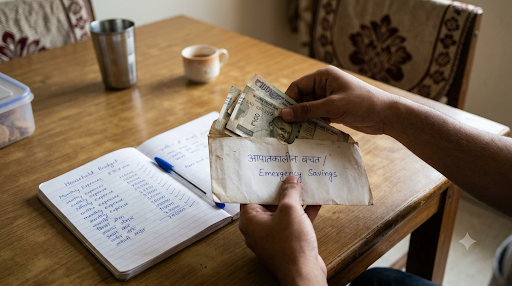
Managing household expenses becomes difficult when rent, groceries, school fees, electricity bills, UPI payments and unexpected purchases all come from the same monthly income.
A household expense tracker India families can use should be simple enough to update every day and detailed enough to show where money is going.
Start by recording every family expense in a notebook, Excel sheet or Google Sheets. Group transactions into categories, set monthly spending limits and compare actual expenses with your budget at the end of each week.
You do not need expensive software or complicated financial calculations. A consistent tracking habit can help your family identify unnecessary spending, prepare for irregular bills and make more informed savings decisions.
This guide explains how to create a practical monthly household expense tracker, with an illustrative ₹50,000 family budget and seven easy steps.
Table of Contents
What Is a Household Expense Tracker?
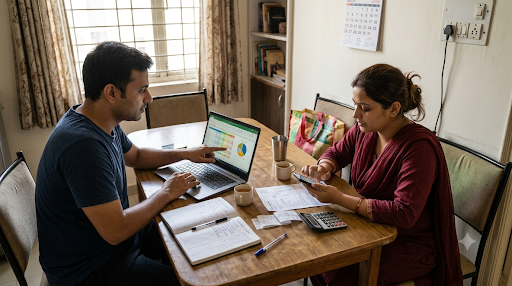
A household expense tracker is a record of money spent by a family on everyday needs, recurring bills, occasional purchases and other financial commitments.
It helps answer three important questions:
- How much money does the family receive every month?
- Where is that money being spent?
- How much is available for savings and future expenses?
For example, a family may know that its monthly income is ₹50,000 but may not know exactly how much goes towards groceries, transportation, online shopping and food delivery.
An expense tracker brings those payments into one organised record.
The Reserve Bank of India’s financial education materials explain that comparing planned expenses with actual spending helps households understand their finances and improve budgeting decisions.
Why Indian Families Need a Monthly Expense Tracker
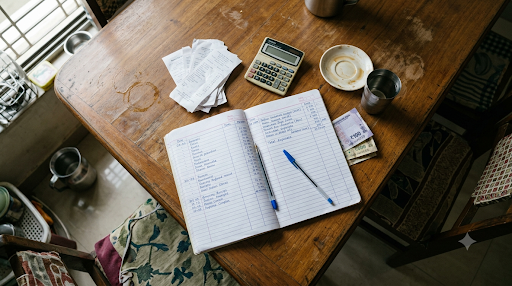
Indian households often manage several different types of payments within a single month.
Some expenses are predictable, such as rent and school fees. Others change depending on electricity consumption, grocery prices, medical needs or family events.
A monthly tracking system helps families handle these differences.
1. Understand Where Family Income Goes
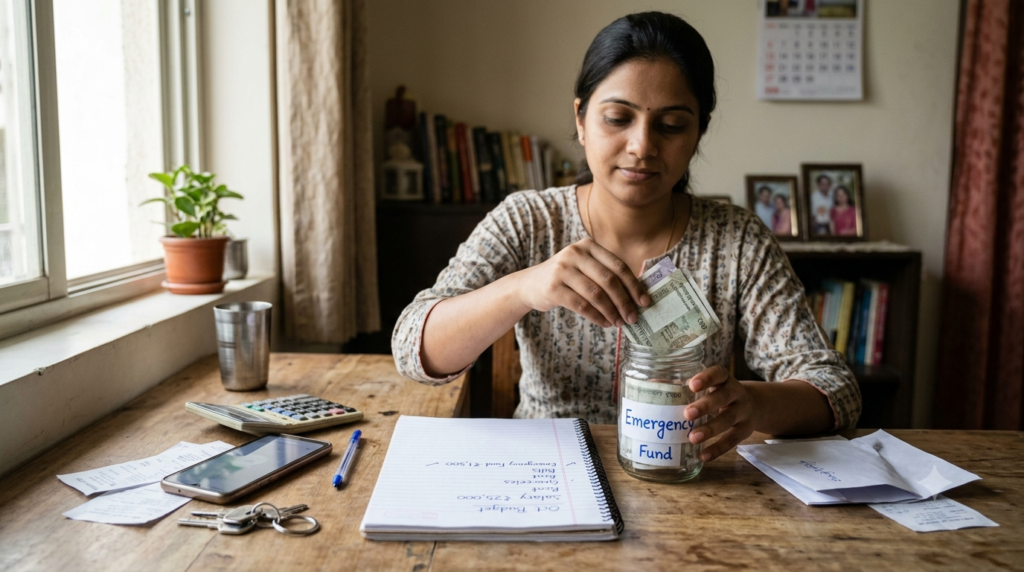
Small purchases are easy to overlook.
A ₹100 snack, ₹250 online order or ₹180 delivery charge may not appear significant individually.
But repeated purchases can become a noticeable monthly expense.
Tracking makes these spending patterns visible.

2. Avoid Running Short Before Salary Day
A family may spend heavily during the first two weeks and struggle to cover bills towards the end of the month.
A tracker shows how much of each category’s budget has already been used.
3. Prepare for School Fees and Annual Bills
Not every household expense occurs monthly.
School admissions, insurance renewals, festivals, appliance repairs and family travel may require larger payments.
Recording these future obligations helps prevent them from becoming last-minute surprises.
4. Make Family Financial Decisions Together
A shared tracker allows earning members and other household decision-makers to understand spending priorities.
It can also reduce confusion about who paid which bill.
5. Build Better Savings Habits
Tracking alone does not create savings.
However, it helps identify spending that can be adjusted without compromising essential family needs.
Household Expense Tracker India: Categories to Include
A useful household expense tracker India families maintain should reflect their actual lifestyle rather than a generic international budgeting template.
Consider these categories:
| Expense Category | Examples |
|---|---|
| Housing | Rent, maintenance, housing-related charges |
| Groceries | Rice, dal, vegetables, fruits, cooking oil |
| Utilities | Electricity, water, LPG, mobile, internet |
| Transportation | Petrol, bus, metro, auto fares |
| Education | School fees, books, tuition |
| Healthcare | Medicines, consultations, tests |
| Insurance | Health, life and other premiums |
| Debt Payments | Home loan, personal loan, other EMIs |
| Personal Spending | Clothing, grooming, subscriptions |
| Entertainment | Movies, restaurants, outings |
| Family Support | Financial help to relatives |
| Irregular Expenses | Festivals, repairs, celebrations |
Keep savings and investments in a separate section. They are allocations of income, not ordinary consumption expenses.
This distinction helps you see how much the family spends, saves and commits towards financial goals.
Example: Monthly Household Budget for a ₹50,000 Income
Consider a hypothetical Indian family with a combined take-home monthly income of ₹50,000.
The following figures are illustrative, not national averages or recommended spending limits.
| Category | Monthly Budget |
|---|---|
| Rent and maintenance | ₹12,000 |
| Groceries and household supplies | ₹8,000 |
| Electricity, LPG and utilities | ₹2,500 |
| Transportation | ₹4,000 |
| Children’s education | ₹5,000 |
| Healthcare | ₹1,500 |
| Insurance | ₹2,000 |
| Mobile and internet | ₹1,000 |
| Entertainment and personal spending | ₹3,000 |
| Emergency fund contribution | ₹3,000 |
| Other savings | ₹5,000 |
| Irregular expense reserve | ₹3,000 |
| Miscellaneous buffer | ₹1,000 |
| Total | ₹50,000 |
In this example, the family allocates ₹8,000 to emergency savings and other savings combined.
The ₹3,000 irregular expense reserve is intended for future spending, not necessarily long-term savings.
Actual budgets will differ depending on city, household size, rent, school fees, existing debt and medical requirements.
A family with a large EMI may need a very different allocation.
Practical takeaway: Start with actual bills and spending records. Adjust the budget to your family’s circumstances rather than forcing expenses into arbitrary percentages.
How to Create a Monthly Household Expense Tracker in 7 Steps
Step 1: Calculate Total Monthly Household Income
List the income available to support household expenses.
Possible sources include:
- Take-home salaries
- Business income after business expenses
- Pension income
- Rental income after related expenses
- Regular family contributions
- Other dependable income
Avoid counting transfers between family members as additional household income.
For example, if one spouse transfers ₹10,000 from an already-counted salary to a shared account, the transfer is not new income.
For irregular income, consider a conservative monthly planning amount based on past receipts.
Step 2: List Fixed and Variable Expenses
Divide expenses into two broad groups.
Fixed or committed expenses are relatively predictable:
- Rent
- School fees
- Loan EMIs
- Regular insurance contributions
- Subscription charges
Variable expenses change throughout the month:
- Groceries
- Fuel
- Electricity
- Restaurants
- Shopping
- Medical purchases
Some bills, such as school fees or insurance premiums, may be paid quarterly or annually. Record their actual due dates and create a monthly reserve where appropriate.
This separation helps identify which expenses can be adjusted quickly.
Step 3: Create a Simple Tracking Sheet
Open Excel, Google Sheets or a notebook.
Create the following columns:
| Date | Expense | Category | Amount | Payment Mode |
|---|---|---|---|---|
| 1 Oct | Vegetables | Groceries | ₹350 | UPI |
| 2 Oct | Bus pass | Transport | ₹900 | UPI |
| 3 Oct | Milk | Groceries | ₹70 | Cash |
| 4 Oct | Electricity bill | Utilities | ₹1,450 | Net banking |
| 5 Oct | Medicines | Healthcare | ₹420 | Card |
These are sample transactions.
For a spreadsheet, keep the amount column numeric rather than typing the rupee symbol into each cell.
Use currency formatting to display ₹.
You can add optional columns for the person who paid, whether the expense was essential and any notes.
Step 4: Record Expenses Every Day
Enter transactions on the same day whenever possible.
Include cash, UPI, debit card, credit card and bank transfer purchases.
Do not rely entirely on memory at the end of the month.
A five-minute evening review may be enough for a household with a manageable number of transactions.
If multiple family members make purchases, agree on one shared system.
Step 5: Set Monthly Limits for Each Category
Create a budget for groceries, transport, entertainment and other relevant categories.
Compare spending against these limits.
For example:
| Category | Budget | Actual | Difference |
|---|---|---|---|
| Groceries | ₹8,000 | ₹8,700 | -₹700 |
| Transport | ₹4,000 | ₹3,600 | +₹400 |
| Entertainment | ₹3,000 | ₹2,200 | +₹800 |
A negative difference indicates overspending. A positive difference indicates unused budget.
The aim is not to make every category perfectly match its budget.
Instead, understand why differences occurred and whether adjustments are necessary.
Step 6: Review Spending Every Week
Choose one day for a short family budget review.
Check:
- Categories approaching their limits
- Unrecorded cash purchases
- Duplicate entries
- Upcoming bills
- Credit card purchases not yet paid
- Unexpected medical or repair expenses
For groceries, compare spending against the remaining weeks rather than judging only the month-to-date total.
For example, if most of the grocery budget has been used during the first week, the family may need to reconsider shopping plans.
Step 7: Calculate Monthly Expenses and Plan Next Month
At month-end, calculate:
Total Household Expenses = Sum of Recorded Expense Transactions
Then calculate:
Monthly Surplus = Household Income − Household Expenses
The surplus is the amount remaining before separately accounting for savings transfers, investments or other allocations not included as expenses.
For a complete cash allocation review, reconcile income against consumption expenses, debt payments, savings contributions and remaining cash.
Ask three questions:
- Which expenses were higher than expected?
- Which costs can realistically be reduced?
- What upcoming payments require preparation?
Use the answers to create next month’s budget.
How to Make a Household Expense Tracker in Excel
Excel is useful for families who want automatic totals without relying on a dedicated budgeting app.
Recommended Spreadsheet Structure
Create three worksheets:
Sheet 1: Daily Expenses
Use columns for date, description, category, amount and payment method.
Sheet 2: Monthly Budget
Include budgeted amount, actual spending and difference for each category.
Sheet 3: Monthly Summary
Show total income, spending, savings allocations and upcoming commitments.
Useful Excel Formulas
If expense amounts are entered in cells D2 through D200:
=SUM(D2:D200)
This calculates the total recorded expenses.
If categories appear in column C and amounts in column D:
=SUMIF(C2:C200,"Groceries",D2:D200)
This calculates spending categorised as Groceries.
To calculate the difference between a budget in B2 and actual spending in C2:
=B2-C2
To calculate the amount remaining from income in B2 after expenses in C2:
=B2-C2
Use separate cells and labels for each calculation so the sheet remains understandable.
You can also create dropdown menus for expense categories to avoid inconsistent names such as Grocery, Groceries and Food Shopping.
[INTERNAL LINK: Monthly Expense Tracker in Excel for Beginners]
How to Track UPI, Cash and Credit Card Expenses
Many families use more than one payment method.
The challenge is bringing those payments into a single household record.
UPI Payments
Review the transaction history available through your UPI apps and linked bank accounts.
Record purchases under their actual spending category.
For example, a ₹600 UPI payment to a grocery shop belongs under Groceries, not a general UPI category.
UPI is a payment method, not an expense type.
[INTERNAL LINK: How to Track UPI Expenses Every Month]
Cash Expenses
Cash spending can be difficult to reconstruct later.
Record small cash purchases as they happen.
Withdrawing ₹2,000 from an ATM is not itself a household consumption expense. Record the purchases made using that cash instead.
Otherwise, you may count the same money twice.
Credit Card Expenses
Record a credit card purchase when it happens.
When the card bill is paid, mark it as a settlement of the existing liability rather than recording the same purchase again.
Track interest, late fees or other charges separately when applicable.
This approach prevents duplicate expense totals.
Transfers Between Family Accounts
Moving money from one family bank account to another is normally an internal transfer.
It should not increase household income or spending.
Classify the final use of the money instead.
How to Handle Annual and Irregular Household Expenses
One weakness of simple monthly trackers is that they focus only on regular bills.
Consider a family that pays ₹24,000 annually for an insurance premium.
Although the payment happens once a year, the family can set aside:
₹24,000 ÷ 12 = ₹2,000 per month
The same method can be used for predictable school expenses, annual subscriptions, festivals and appliance maintenance.
Keep the monthly reserve separate from actual spending.
When the bill is paid, record the expense and reduce the reserved balance.
Do not treat both the monthly reserve contribution and the eventual payment as consumption expenses.
For genuinely unpredictable emergencies, maintain a separate emergency fund according to your family’s needs and financial capacity.
Common Household Expense Tracking Mistakes
Ignoring Small Transactions
Repeated small purchases can distort the monthly budget when left unrecorded.
Include everyday payments, even when they appear insignificant.
Tracking Only One Family Member
A tracker is incomplete if it records one person’s expenses but ignores purchases made by others.
Use a shared process where practical.
Counting Transfers as Expenses
Bank transfers, ATM withdrawals and credit card bill settlements can cause double-counting.
Separate actual purchases from movement of money.
Treating Savings as Regular Spending
Savings transfers and investments should be tracked, but distinguish them from groceries, utilities and other consumption.
This makes the household’s financial position easier to understand.
Forgetting Irregular Bills
An apparently comfortable monthly budget can become difficult when annual premiums or festival spending arrive.
Plan for predictable future payments.
Creating Too Many Categories
A tracker with dozens of overlapping categories can become difficult to maintain.
Begin with around 10–15 categories and add more only when they help decision-making.
Giving Up After One Expensive Month
A medical emergency or necessary repair may cause unusual spending.
Record the event, understand its impact and continue tracking.
One difficult month does not make the system useless.
Notebook vs Excel vs Google Sheets: Which Is Better?
| Method | Best For | Main Limitation |
|---|---|---|
| Notebook | Families preferring handwritten records | Manual calculations |
| Excel | Detailed budgets and offline spreadsheets | Requires basic spreadsheet skills |
| Google Sheets | Shared tracking across family devices | Sharing permissions and connectivity need attention |
| Budgeting App | Convenient mobile expense entry | Features and privacy practices vary |
The best tracker is the one your family will actually use.
A notebook maintained consistently is more useful than a sophisticated spreadsheet that nobody updates.
For shared digital sheets, restrict access to trusted household members and avoid recording passwords, UPI PINs or other sensitive authentication details.
A Simple Monthly Household Budget Review Routine
A practical expense tracker should support decisions, not become another household burden.
Try this routine:
Daily: Record purchases and payments.
Weekly: Review category spending and upcoming bills.
Monthly: Compare actual expenses with the budget and review savings allocations.
Quarterly: Revisit larger expenses, recurring subscriptions and family goals.
Annually: Review insurance renewals, education costs, major purchases and long-term financial commitments.
If your income changes, adjust the budget rather than continuing with outdated assumptions.
The Securities and Exchange Board of India’s investor education guidance recommends budgeting, prioritising essential expenses, maintaining emergency savings and planning for financial goals.
How Families Can Reduce Expenses Without Sacrificing Essentials
Tracking identifies potential savings opportunities, but every family has different priorities.
Start with costs that can be changed without affecting basic needs.
For groceries, prepare shopping lists and compare quantities, prices and wastage.
For subscriptions, review services that are rarely used.
For food delivery, examine the combined cost of meals, delivery charges and convenience fees.
For utilities, identify avoidable electricity or water consumption.
For transportation, compare commuting options where practical.
Avoid reducing essential healthcare, necessary insurance protection or children’s educational needs simply to make a budget look better.
A sustainable budget should support family wellbeing alongside financial discipline.
[INTERNAL LINK: How to Track Daily Expenses in India]
[INTERNAL LINK: How to Save Money on a ₹25,000 Salary]
Final Monthly Household Expense Tracker Checklist
Before closing the month, confirm that:
- All family income sources have been recorded without duplication.
- Cash, UPI, debit card and credit card purchases are included.
- Every expense has a consistent category.
- Monthly bills and loan obligations are accounted for.
- Transfers and credit card settlements are not double-counted.
- Savings and investments are shown separately.
- Annual and irregular expenses have been considered.
- Actual spending has been compared with the budget.
- Next month’s priorities have been discussed.
A short, consistent review can make the next month’s financial decisions easier.
Conclusion
A household expense tracker India families can maintain does not need to be complicated.
Start with a simple list of income and expenses, organise purchases into meaningful categories and update the record regularly.
Use Excel, Google Sheets or a notebook according to your family’s comfort level.
The real benefit comes from understanding spending patterns, preparing for upcoming obligations and making financial decisions based on actual numbers.
Begin with one month of records. Improve the system as your family’s needs become clearer.
Editorial note: All example household budgets and transactions in this guide are hypothetical illustrations. They are not estimates of typical Indian household spending.
Frequently Asked Questions
1. What is the best household expense tracker for Indian families?
The best household expense tracker depends on your family’s preferences. Excel works well for detailed calculations, Google Sheets is useful for shared tracking, and a notebook is suitable for simple handwritten records. Choose a method that everyone involved can maintain consistently.
2. How do I track monthly household expenses in India?
Start by recording total household income. List all purchases, bills and payments, categorise them, and set monthly budgets. Update your tracker daily, review spending weekly and compare actual expenses with your planned budget at month-end.
3. Can I create a household expense tracker in Excel for free?
You can create a basic tracker using Excel if you already have access to it. Google Sheets and free spreadsheet applications are alternatives. Create columns for date, expense, category, amount and payment method, then use SUM and SUMIF formulas to calculate totals.
4. How much should an Indian family save every month?
There is no single savings percentage suitable for every family. The amount depends on income, essential expenses, existing debt, dependants and financial goals. Start with an affordable, consistent savings allocation and review it when your financial circumstances change.
5. How can I track household UPI expenses?
Review transaction histories from your UPI apps and linked bank accounts. Record each actual purchase in your household tracker under the appropriate category, such as groceries, transport or utilities. Avoid counting transfers between your own accounts as expenses.
6. What expenses should be included in a family budget?
A family budget should account for housing, groceries, utilities, transportation, education, healthcare, insurance, loan payments, personal spending and irregular expenses. It should also include separate allocations for emergency savings, investments and future financial goals.