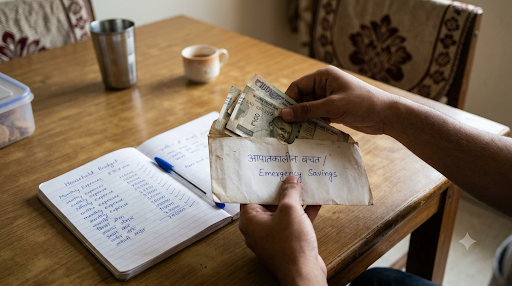
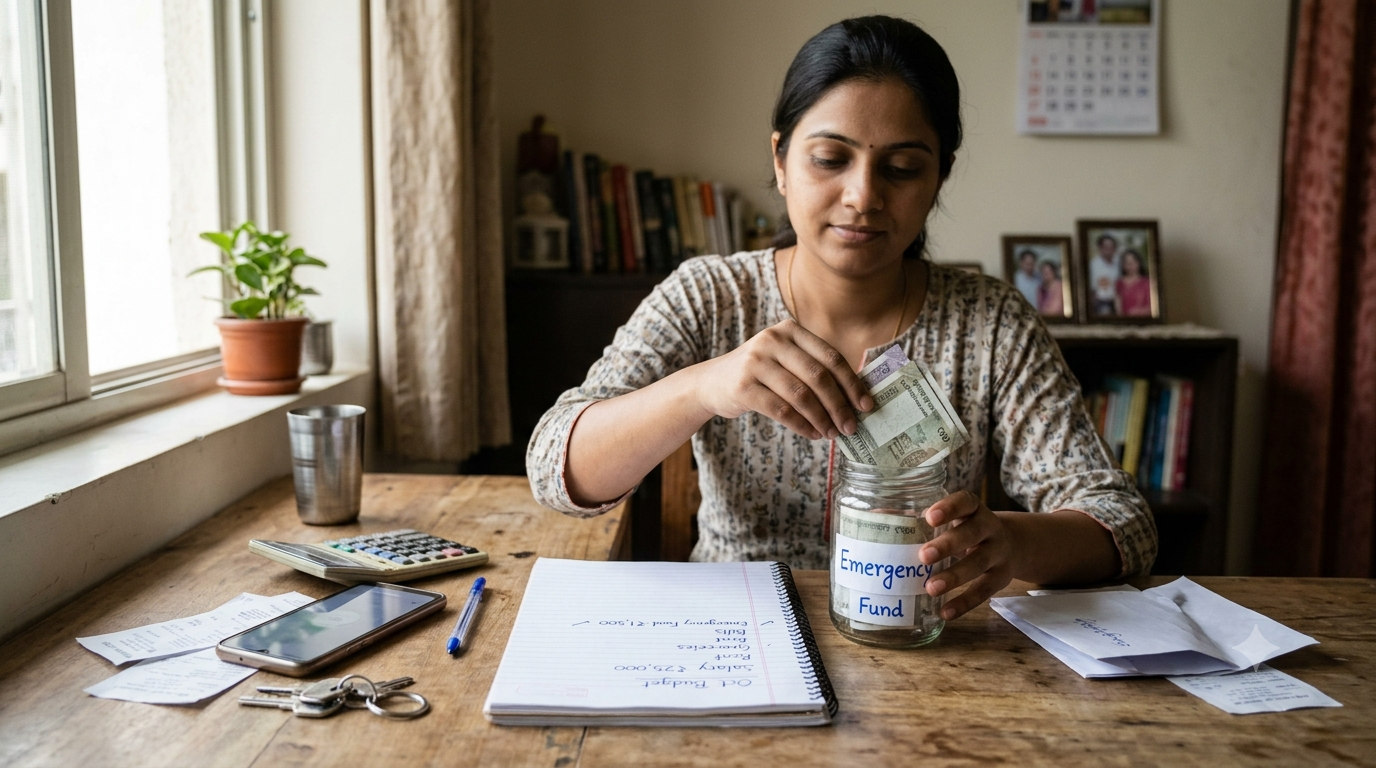
If you are wondering how to save money on 30000 salary, the answer is not to eliminate every enjoyable expense. The more practical approach is to decide where your ₹30,000 will go before the month begins.
For example, you might allocate ₹15,000–₹17,000 to essential expenses, ₹5,000–₹6,000 to savings and financial goals, and use the remaining amount for flexible expenses. The exact numbers will depend on your rent, city, family responsibilities, debt and lifestyle.
Even saving ₹3,000–₹6,000 consistently can create meaningful financial progress over time.
The goal is simple: save first, control the largest expenses, prepare for emergencies and gradually increase your savings as your income rises.
Table of Contents
How to Save Money on 30000 Salary: Start With a Realistic Budget
Budgeting should not mean creating an unrealistic plan that you abandon after one week.
It means understanding your income, identifying necessary expenses and deliberately deciding how much money should go toward savings and other goals.
SEBI’s investor education material describes budgeting as a process of tracking, planning and controlling income and expenses, with reasonable savings remaining after expenses.
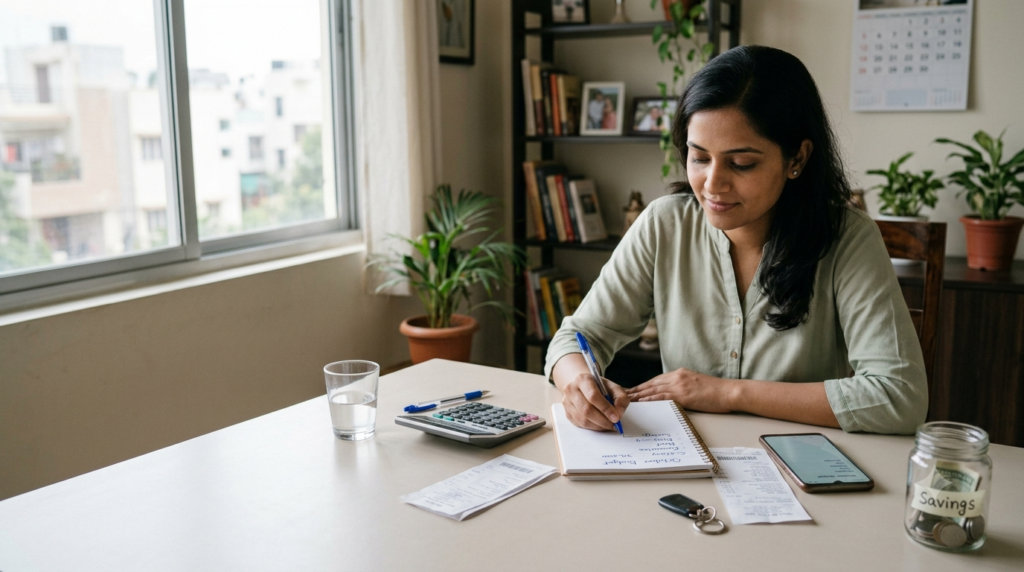
For someone earning ₹30,000 per month, a sample starting budget could look like this:
| Category | Example Monthly Amount |
|---|---|
| Rent and housing | ₹8,000 |
| Groceries and food | ₹5,000 |
| Transport | ₹2,500 |
| Utilities/mobile/internet | ₹2,000 |
| Insurance/health/personal essentials | ₹2,000 |
| Emergency fund | ₹3,000 |
| Long-term savings/investments | ₹3,000 |
| Lifestyle/miscellaneous | ₹4,500 |
| Total | ₹30,000 |
This is an illustrative budget, not a universal formula.
Someone living with family may be able to save significantly more. Someone paying high rent in a major city may need to reduce another category or initially set a smaller savings target.
The important number is not a perfect savings percentage. It is the amount you can save consistently without repeatedly withdrawing it before the next salary arrives.

1. Save Money as Soon as Your Salary Arrives
One of the easiest mistakes is treating savings as whatever remains at the end of the month.
Reverse the process.
When your salary arrives, transfer your planned savings amount immediately to a separate account or designated financial goal.
Suppose you decide to save ₹5,000.
Your monthly calculation becomes:
₹30,000 income − ₹5,000 savings = ₹25,000 available for spending
instead of:
₹30,000 income − all expenses = whatever is left to save
This simple change creates a clear spending boundary.
If ₹5,000 feels unrealistic initially, begin with ₹2,000 or ₹3,000. A sustainable amount saved every month is more useful than an aggressive target you cannot maintain.

2. Keep Housing Costs Under Control
For many salaried people, rent is one of the largest monthly expenses.
That makes housing one of the first places to examine when trying to save more.
If you earn ₹30,000 and spend ₹15,000–₹18,000 on rent, a large part of your income disappears before groceries, transportation, bills and savings are considered.
Possible ways to reduce housing expenses include:
- sharing accommodation
- choosing a slightly less expensive neighbourhood
- living closer to work if it reduces commuting costs
- negotiating rent when renewing a lease
- avoiding unnecessary upgrades simply because your salary increased
Do not judge rent in isolation.
A cheaper home far from work may increase transportation expenses enough to erase the savings.
Compare your total housing plus commuting cost.
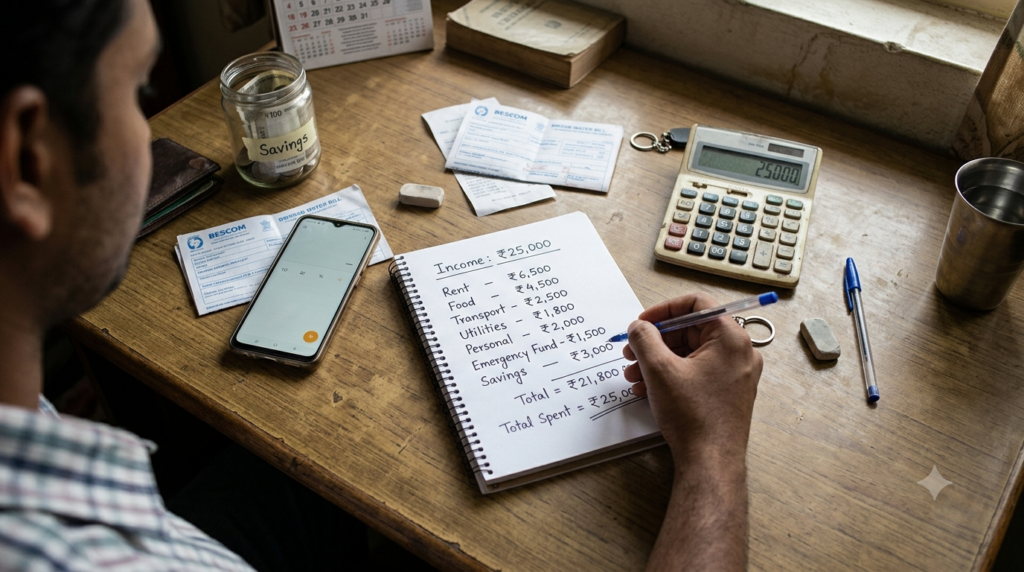
3. Build an Emergency Fund Before Lifestyle Upgrades
Unexpected expenses are one reason a carefully planned monthly budget can collapse.
A medical expense, urgent journey, vehicle repair or temporary income disruption can force you to borrow if you have no financial buffer.
Start small.
Your first milestone might simply be ₹10,000 or another amount appropriate to your essential expenses.
Then gradually work toward a larger emergency reserve based on your own monthly necessities and financial responsibilities.
For example, if you save ₹3,000 every month toward emergencies:
₹3,000 × 6 months = ₹18,000
The purpose of an emergency fund is not to maximize returns.
Its purpose is to give you accessible money when a genuine unexpected expense appears.
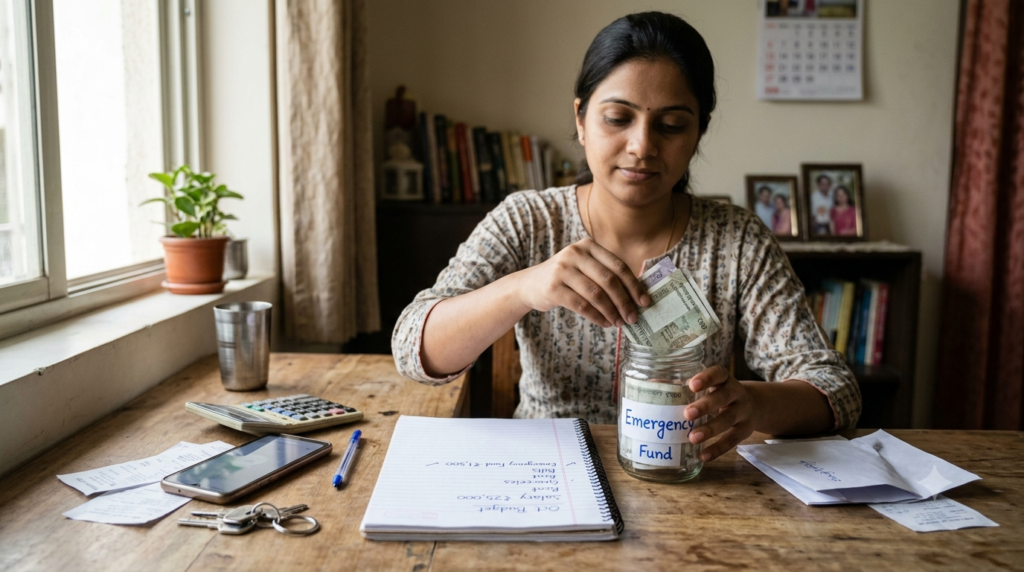
Keep emergency savings separate from routine spending so you are less tempted to use the money for shopping or entertainment.

4. Control Food and Convenience Spending
Small purchases become expensive when they happen frequently.
Consider expenses such as:
- food delivery
- restaurant meals
- coffee and snacks
- convenience-store purchases
- frequent cab rides
- impulse online orders
You do not necessarily need to eliminate them.
Instead, give these expenses a monthly limit.
For example, if you currently spend ₹4,000 on food delivery and outside meals, reducing it to ₹2,500 frees ₹1,500.
That ₹1,500 redirected every month becomes ₹18,000 over 12 months.
This illustrates why recurring expenses deserve more attention than occasional small purchases.
5. Track Your Expenses for One Month
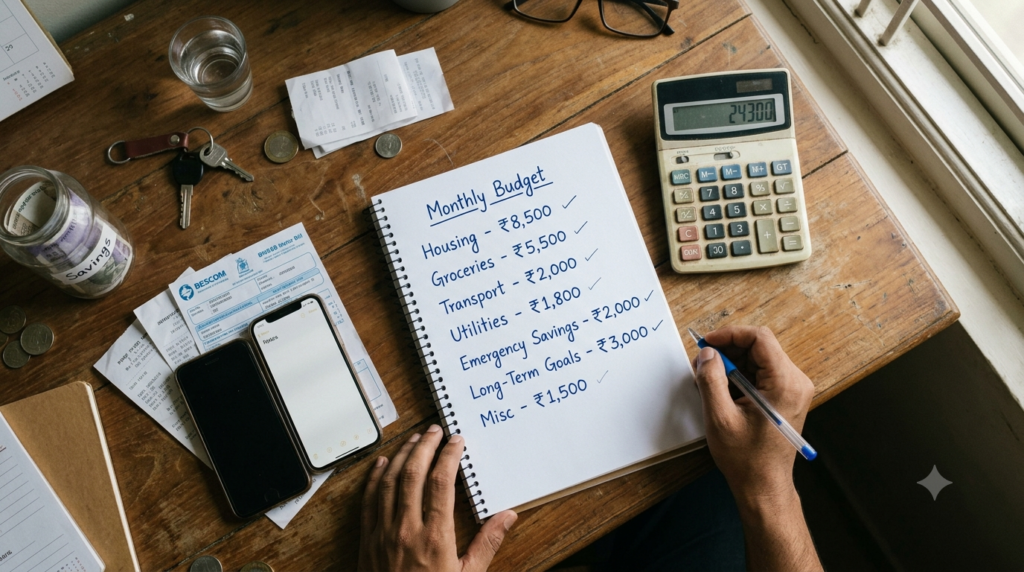
If you repeatedly reach the final week of the month wondering where your salary went, track every meaningful expense for 30 days.
Use whatever system you will actually maintain:
- spreadsheet
- budgeting app
- bank statement
- notebook
- phone notes
Divide expenses into categories such as housing, groceries, transportation, subscriptions, debt payments, shopping and entertainment.
At the end of the month, identify three things:
Essential expenses: difficult to eliminate.
Flexible expenses: necessary but adjustable.
Optional expenses: can be reduced without affecting basic needs.
Do not try to cut 20 categories simultaneously.
Find the two or three areas consuming the most unnecessary money and start there.
6. Avoid Increasing Your Lifestyle With Every Salary Increase
A higher salary can improve your financial position, but only if your expenses do not rise equally fast.
Imagine your salary eventually increases from ₹30,000 to ₹35,000.
If your lifestyle immediately consumes the additional ₹5,000, your savings may remain unchanged.
Instead, consider automatically directing part of every future increment toward savings or investments.
For example, you might use part of an increment to improve your lifestyle and direct another part toward financial goals.
This allows your quality of life and savings capacity to improve together.
7. Give Every Saving Goal a Purpose
Saving becomes easier when the money has a clear job.
Instead of one vague goal called “savings,” divide your goals.
They might include:
- emergency fund
- annual insurance premiums
- education or skill development
- vehicle purchase
- travel
- home deposit
- retirement
- other long-term financial goals
SEBI’s financial education material encourages specific, realistic and time-bound financial goals rather than vague intentions to save.
For example:
“I want to save money” is vague.
“I will save ₹3,000 every month toward my emergency fund” gives you an amount and a purpose.
Once you know the goal, choosing how much to save becomes easier.
A Practical ₹30,000 Salary Saving Plan
Here is another way to structure the monthly salary:
Salary Day
Income received: ₹30,000
Immediately transfer:
Emergency fund: ₹3,000
Long-term savings/investments: ₹3,000
Amount remaining for the month: ₹24,000
Monthly Spending Limit
Housing: ₹8,000
Food and groceries: ₹5,000
Transport: ₹2,500
Utilities: ₹2,000
Health/personal essentials: ₹2,000
Lifestyle and miscellaneous: ₹4,500
Total spending: ₹24,000
Total allocated toward savings and goals: ₹6,000
Under this example, ₹6,000 represents 20% of ₹30,000.
But 20% is not a mandatory target.
If your current responsibilities allow only ₹3,000, start there. If you live with family and have lower fixed expenses, you may be able to save substantially more.
Your budget should reflect your actual circumstances.
What If You Cannot Save ₹5,000–₹6,000?
Do not abandon budgeting because an ideal-looking number feels impossible.
Start with the amount you can genuinely protect every month.
Even ₹2,000 per month equals:
₹2,000 × 12 = ₹24,000 in a year.
Then look for ways to gradually increase that amount.
Ask:
Can I reduce rent?
Can I lower commuting costs?
Can I reduce food delivery?
Am I paying for subscriptions I rarely use?
Can I eliminate a high-cost debt payment?
Can I increase my income through skills, overtime, freelancing or a better-paying role?
There is a limit to how much expenses can be reduced. Income growth eventually becomes an important part of improving your financial position.
Should You Save or Invest on a ₹30,000 Salary?
Saving and investing serve different purposes.
Money needed for routine expenses or near-term emergencies generally needs accessibility. Long-term goals may allow you to consider appropriate investment products depending on your time horizon, risk tolerance and circumstances.
Do not invest money that you may urgently need next month simply because you want higher returns.
First establish control over your monthly cash flow and create an emergency buffer.
Then learn about investment choices and their risks before committing money.
[INTERNAL LINK: Saving Money on a Low Salary]
[INTERNAL LINK: Best Monthly Budget for ₹20,000 Salary]
[INTERNAL LINK: How to Build an Emergency Fund in India]
Common Mistakes to Avoid on a ₹30,000 Salary
Saving Only What Is Left at Month-End
Expenses tend to expand when the full salary remains available in your spending account.
Transfer savings earlier.
Following an Unrealistic Budget
A budget that leaves no money for occasional entertainment or personal spending may be difficult to maintain.
Build reasonable flexibility into it.
Using Credit for Lifestyle Expenses
Repeatedly borrowing for shopping, dining or non-essential purchases can shift future income toward past consumption.
Ignoring Small Recurring Payments
A single subscription may look insignificant. Several unused subscriptions combined with delivery fees and impulse purchases can become meaningful.
Investing Without an Emergency Buffer
An unexpected expense can force you to sell investments or borrow at an inconvenient time.
Keep emergency planning separate from long-term investing.
How Much Can You Save in One Year on a ₹30,000 Salary?
The answer depends entirely on how much you consistently set aside.
Here are simple examples:
| Monthly Saving | Saving After 12 Months* |
|---|---|
| ₹2,000 | ₹24,000 |
| ₹3,000 | ₹36,000 |
| ₹4,000 | ₹48,000 |
| ₹5,000 | ₹60,000 |
| ₹6,000 | ₹72,000 |
*These figures simply multiply monthly contributions by 12 and do not assume interest or investment returns.
This table shows why consistency matters.
You do not need a dramatic financial transformation in one month.
You need a system you can repeat.
Practical Takeaway
Learning how to save money on 30000 salary is primarily about creating a gap between what you earn and what you spend—and protecting that gap every month.
Start by tracking your expenses.
Create a realistic budget.
Move savings immediately after receiving your salary.
Build an emergency fund.
Control major expenses such as housing, food and transportation.
Avoid automatically increasing your lifestyle whenever your income increases.
Then gradually increase the amount directed toward long-term goals as your financial position improves.
A ₹30,000 salary may place real limits on your budget, particularly when you have high rent, debt or family responsibilities. But even a modest, repeatable saving habit can create a stronger financial foundation than waiting indefinitely for the “perfect” income to begin.
Frequently Asked Questions
1. How much should I save from a ₹30,000 salary?
There is no compulsory savings percentage that works for everyone. If your expenses allow it, saving ₹3,000–₹6,000 a month can be a practical starting range. If that is currently difficult, begin with a smaller amount and increase it as expenses fall or income rises.
2. Can I save ₹10,000 from a ₹30,000 salary?
It may be possible if your housing and other fixed expenses are low—for example, if you live with family or share accommodation. Saving ₹10,000 while paying high rent and supporting dependants may be unrealistic. Build the target around your actual essential expenses.
3. What is a good budget for a ₹30,000 salary in India?
One illustrative budget could allocate ₹8,000 to housing, ₹5,000 to food, ₹2,500 to transport, ₹4,000 to utilities and personal essentials, ₹6,000 to savings and financial goals, and ₹4,500 to lifestyle and miscellaneous expenses. Adjust these figures according to your circumstances.
4. Should I save or invest first on a ₹30,000 salary?
Start by getting control of your monthly budget and building an accessible emergency buffer. Once you can handle unexpected expenses without immediately borrowing, you can evaluate suitable investments for longer-term goals according to your risk tolerance and time horizon.
5. How can I save money when most of my ₹30,000 salary goes toward expenses?
Track your spending for a full month and focus first on the largest adjustable expenses. Housing, commuting, food delivery, subscriptions and discretionary shopping may offer more meaningful savings than cutting tiny purchases individually. If expenses are already tightly controlled, improving income becomes increasingly important.
6. How much will I save in a year if I save ₹5,000 per month?
Saving ₹5,000 every month for 12 months gives you ₹60,000 in contributions. This simple calculation does not include any interest or investment returns.