
Managing a ₹20,000 monthly income can feel difficult when rent, groceries, transport, bills, and unexpected expenses all compete for the same money.
One way to bring more structure to a limited income is zero-based budgeting.
A zero based budget for 20000 salary gives every rupee a purpose before you spend it. Instead of spending throughout the month and saving whatever remains, you decide in advance how much money will go toward necessities, savings, personal expenses, and other financial priorities.
This does not mean you need to spend your entire ₹20,000.
Savings, emergency funds, investments, and planned future expenses can all be treated as budget categories. The goal is simply:
Income − Planned Expenses − Savings = ₹0
Here is a practical example for an Indian employee earning ₹20,000 per month.
Table of Contents
What Is a Zero-Based Budget?
Zero-based budgeting is a budgeting method in which you assign your entire monthly income to specific categories.
Suppose your take-home salary is ₹20,000.
Instead of thinking:
“I have ₹20,000 available to spend this month.”
You could divide it among categories such as:
- Rent
- Groceries
- Transport
- Utilities
- Mobile and internet
- Healthcare
- Personal spending
- Emergency savings
- Long-term savings
After allocating the full ₹20,000, the amount left unassigned should be zero.
Importantly, a zero balance in your budget does not mean a zero bank balance. It means every rupee has been assigned a job.
Zero Based Budget for ₹20,000 Salary: Example
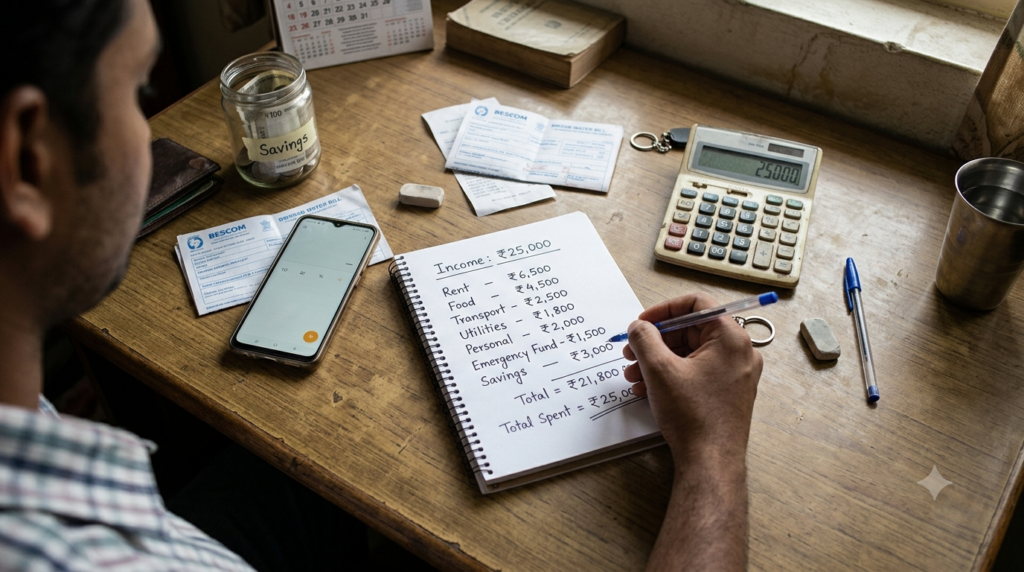
Here is one illustrative monthly budget.
| Category | Amount |
|---|---|
| Rent / Shared Accommodation | ₹6,000 |
| Groceries & Food | ₹3,500 |
| Transport | ₹1,500 |
| Electricity / Utilities | ₹800 |
| Mobile & Internet | ₹500 |
| Healthcare / Medicines | ₹500 |
| Personal Expenses | ₹1,000 |
| Family / Miscellaneous | ₹1,000 |
| Emergency Fund | ₹2,000 |
| Long-Term Savings / Investment | ₹2,000 |
| Buffer | ₹1,200 |
| Total | ₹20,000 |
In this example:
Monthly income = ₹20,000
Total planned allocation = ₹20,000
Money left unassigned = ₹0
That is the basic idea behind a zero-based budget.
The amounts above are only an example. Your actual budget should reflect your rent, location, family responsibilities, debt, health expenses, and other circumstances.
Step 1: Start With Your Actual Take-Home Salary
Start with the money that actually reaches your bank account.
If your stated salary is ₹22,000 but deductions leave you with ₹20,000, build your budget around ₹20,000—not ₹22,000.
For this example:
Take-home monthly income: ₹20,000
If you receive variable income such as incentives, overtime, freelance income, or commissions, avoid automatically depending on uncertain income to pay essential fixed expenses.
You can create a separate plan for additional income when you actually receive it.
Step 2: List Your Essential Expenses
Next, identify expenses that are difficult to avoid.
For someone earning ₹20,000, these may include:
- Rent
- Groceries
- Work commute
- Electricity
- Mobile recharge
- Internet
- Medicines
- Basic household expenses
In our example, the largest expense is ₹6,000 for accommodation.
Housing can significantly affect whether a ₹20,000 salary feels manageable.
Someone paying ₹10,000 in rent will need a completely different budget from someone paying ₹4,000 while sharing accommodation or living with family.
So don’t copy another person’s budget blindly.
Use the example as a framework and adjust the numbers to your situation.

Step 3: Give Food a Fixed Budget
Food is essential, but it is also a category where small unplanned purchases can accumulate.
For this budget, we allocate:
Groceries and food: ₹3,500
This could include groceries, basic cooking ingredients, and limited outside food.
If you regularly order meals through delivery apps or eat at restaurants, your actual spending could be considerably higher.
Try separating:
Essential food: groceries and regular meals
from
Lifestyle food: restaurants, snacks, delivery orders, and café spending.
This makes it easier to see where adjustments are possible.

Step 4: Plan Your Transportation Costs
We have allocated:
Transport: ₹1,500
Your actual transportation expense depends heavily on how you commute.
It may include:
- Bus fares
- Metro fares
- Fuel
- Auto-rickshaw expenses
- Two-wheeler costs
- Occasional cab expenses
If commuting costs ₹80 every working day for 25 days, that alone equals ₹2,000.
Calculate your real monthly commuting expense rather than choosing an arbitrary amount.
If transport consistently exceeds your budget, consider practical alternatives such as public transport, carpooling, combining errands, or reducing unnecessary cab trips where feasible.
Step 5: Budget for Bills Before They Arrive
Some bills may look small individually but collectively consume a noticeable portion of a ₹20,000 income.
Our example allocates:
- Utilities: ₹800
- Mobile and internet: ₹500
That is ₹1,300 per month.
Review recurring subscriptions as well.
A ₹149 or ₹299 monthly subscription may not look significant, but several subscriptions together can reduce the money available for savings or essential expenses.
Keep subscriptions you genuinely use and reconsider those providing little value.
Step 6: Make Savings a Budget Category
One of the most useful features of zero-based budgeting is that savings don’t have to be whatever happens to remain at the end of the month.
You can assign money to savings at the beginning.
Our example includes:
Emergency fund: ₹2,000
Long-term savings/investment: ₹2,000
Total allocated toward these goals:
₹4,000 per month
That represents 20% of the ₹20,000 income in this illustrative budget.
However, ₹4,000 will not be realistic for everyone.
If high rent, debt repayments, family obligations, or medical costs make this difficult, start with a smaller sustainable amount rather than abandoning saving completely.
The important habit is to give savings a deliberate place in your budget.
Step 7: Build an Emergency Fund Gradually
An emergency fund is money reserved for genuine unexpected expenses.
Examples might include:
- Urgent medical costs
- Essential repairs
- Temporary loss of income
- Necessary travel during a family emergency
- Unexpected essential bills
In our example, ₹2,000 goes toward the emergency fund each month.
If you saved ₹2,000 monthly for 12 months without withdrawals, your contributions would total:
₹2,000 × 12 = ₹24,000
Over time, you can work toward an emergency reserve appropriate for your essential expenses and circumstances.
Keep emergency savings accessible and separate from routine spending so that normal purchases don’t gradually consume them.
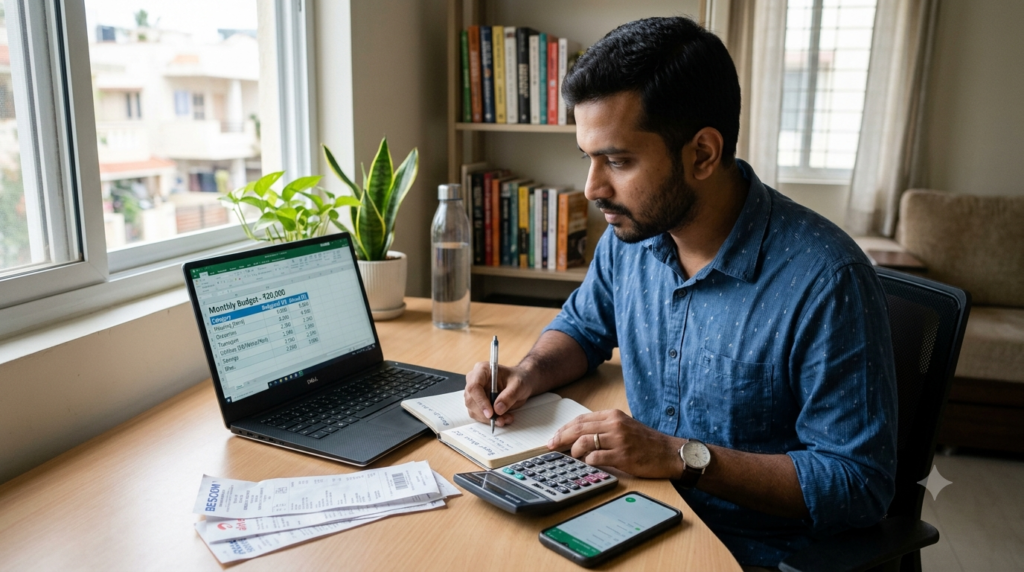
Step 8: Keep a Buffer for Irregular Expenses
Real life rarely follows a perfect spreadsheet.
That is why our example includes:
Buffer: ₹1,200
The buffer can help cover small irregular expenses that were not perfectly predicted.
For example:
- A slightly higher electricity bill
- Minor household repairs
- An unexpected work expense
- A small price increase
- An essential purchase you forgot to budget for
Without a buffer, even a relatively small surprise can disrupt the entire monthly plan.
However, don’t automatically treat the buffer as extra spending money.
If you don’t need all of it, consider carrying it forward or moving the unused amount toward savings or another financial goal.
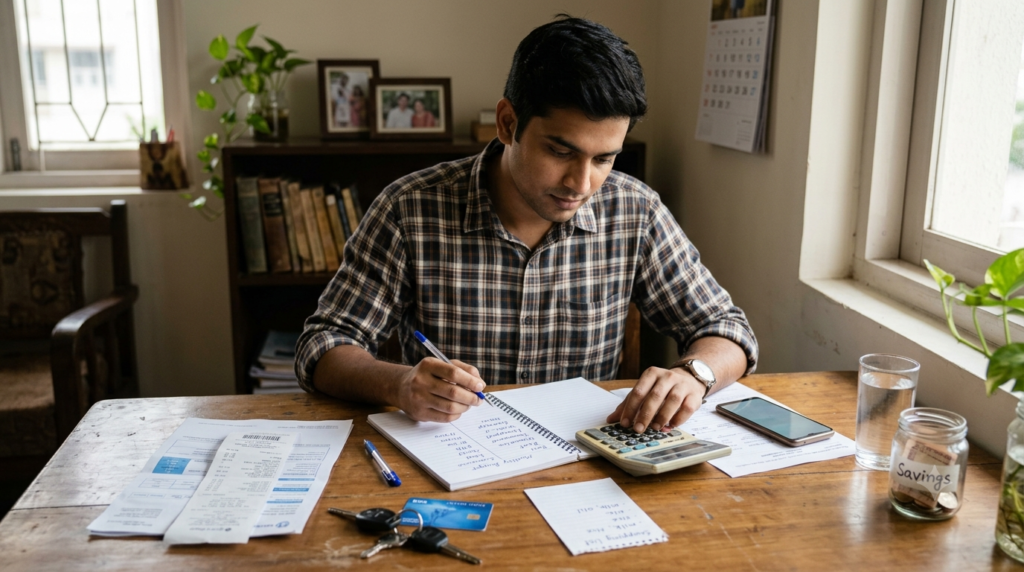
Step 9: Track Actual Spending
Creating a budget is only the first part.
You also need to compare your plan with what you actually spend.
You can track expenses using:
- A spreadsheet
- A budgeting app
- Your bank statement
- UPI transaction history
- A simple notebook
Suppose you budgeted ₹3,500 for food but spent ₹4,200.
You are ₹700 over budget.
Under zero-based budgeting, you should account for that ₹700 by reducing another flexible category, using part of your planned buffer, or adjusting future spending.
The important point is not to ignore the difference.
Step 10: Review Your Budget Every Month
Your budget does not have to remain identical forever.
Expenses change.
Rent may increase.
Transport costs may fall.
Your salary may increase.
A loan may be repaid.
Family responsibilities may change.
At the end of each month, ask:
- Where did I overspend?
- Which category was unrealistic?
- Did I save what I planned?
- Were there expenses I forgot to include?
- What should I change next month?
A zero-based budget becomes more useful when it reflects your actual life rather than an idealised spending plan.
What If Your Expenses Are More Than ₹20,000?
This is where zero-based budgeting can reveal an important problem.
Imagine your essential expenses and commitments total ₹22,500 while your take-home salary is ₹20,000.
You have a:
₹2,500 monthly shortfall
A budget cannot make that gap disappear.
You would need to examine whether you can reduce expenses, restructure certain commitments where appropriate, or increase income.
Start with flexible spending before cutting essential needs.
Possible areas to review include:
- Housing costs
- Food delivery
- Entertainment
- Subscriptions
- Cab usage
- Non-essential shopping
- Unnecessary fees
- Expensive debt
If essential expenses alone exceed your income, the problem may require a larger change rather than increasingly strict day-to-day budgeting.
Zero-Based Budget vs 50/30/20 Rule
Both approaches can be useful, but they work differently.
The 50/30/20 framework generally divides income into broad buckets for needs, wants, and savings/debt repayment.
Zero-based budgeting is more detailed.
Every rupee receives a specific purpose.
For someone earning ₹20,000, that extra detail can be useful because even a ₹500–₹1,000 difference may materially affect the monthly plan.
You don’t necessarily need to treat budgeting methods as competing systems.
You could use a broad percentage framework as a starting point and then create detailed zero-based categories underneath it.
Simple Zero-Based Budget Formula
Use this formula:
Monthly Income − Expenses − Savings = ₹0
For example:
₹20,000 income
minus
₹16,000 planned expenses
minus
₹4,000 planned savings
equals
₹0 unassigned
The ₹4,000 has not disappeared—it has simply been assigned to savings rather than spending.
How to Make a ₹20,000 Salary Budget More Sustainable
A good budget should be realistic enough to follow month after month.
Avoid creating an extremely restrictive plan that assumes you will never have personal expenses or unexpected costs.
Instead:
- Cover essential expenses first.
- Allocate an amount toward savings that you can realistically maintain.
- Put limits on flexible spending.
- Maintain a small buffer.
- Track actual expenses.
- Review and adjust the plan monthly.
As your income grows, consider increasing savings deliberately rather than allowing every salary increase to turn into higher lifestyle spending.
Final Thoughts
A zero based budget for 20000 salary can give you a clearer picture of where your money needs to go each month.
Instead of waiting until the end of the month to discover what remains, you decide in advance how your ₹20,000 will be allocated.
A sample plan could assign money toward rent, groceries, transport, bills, healthcare, personal spending, emergency savings, long-term savings, and a buffer until the entire ₹20,000 has a defined purpose.
The exact numbers will differ from person to person.
What matters is the principle:
Don’t leave your money without a plan. Give every rupee a job.
Start with your next salary, track what actually happens, and improve the budget month by month.
Disclaimer: This article is for general educational and informational purposes only. Budget examples are illustrative and may not be suitable for every household. Consider your own income, obligations, financial goals, and circumstances before making financial decisions.
Frequently Asked Questions
1. What is a good zero based budget for 20000 salary?
A practical zero-based budget assigns the full ₹20,000 to necessary expenses, savings, financial goals, and a small buffer. For example, you might allocate ₹6,000 to rent, ₹3,500 to food, ₹1,500 to transport, ₹1,300 to utilities and connectivity, ₹2,000 to an emergency fund, ₹2,000 to long-term savings, and the remainder to healthcare, personal, miscellaneous, and buffer categories. Your actual allocation should reflect your circumstances.
2. Can I save money on a ₹20,000 salary?
Yes, depending on your essential expenses and financial commitments. Start with an amount you can consistently afford. Even if you cannot immediately reach a particular savings percentage, regularly setting aside a manageable amount can help establish the habit.
3. Does zero-based budgeting mean spending my entire salary?
No. Zero-based budgeting means assigning every rupee a purpose. Savings, investments, emergency funds, and money reserved for future expenses can all be categories. Your budget reaches zero because nothing remains unassigned, not because you have spent everything.
4. How much should I spend on rent with a ₹20,000 salary?
There is no single rent amount suitable for everyone. Housing costs depend on location, household size, commute, and available alternatives. In the example in this article, ₹6,000 is allocated to shared accommodation or rent, but you should use your actual housing costs when building your budget.
5. How much emergency fund should I save from a ₹20,000 salary?
Start with an amount you can consistently set aside after covering essential expenses. In our illustrative budget, ₹2,000 per month goes to emergency savings. Your eventual emergency-fund target should reflect your essential monthly expenses, income stability, dependants, and other circumstances.
6. Is zero-based budgeting suitable for beginners?
Yes. The basic principle is straightforward: calculate your take-home income, list your expenses and financial goals, and assign your available money until there is nothing left unallocated. Tracking your actual spending then helps you improve the next month’s budget.