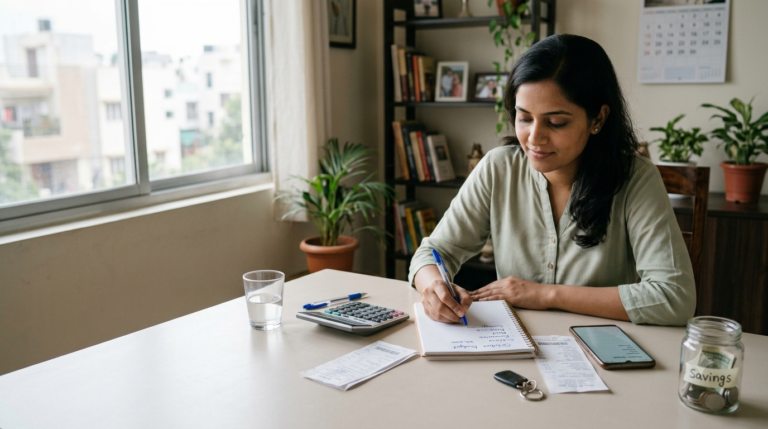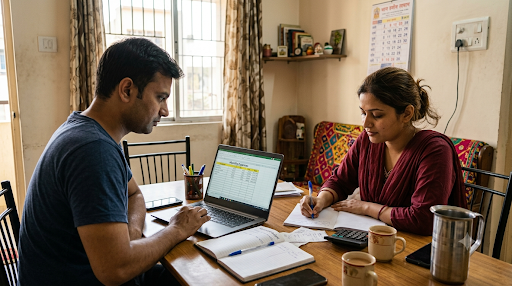
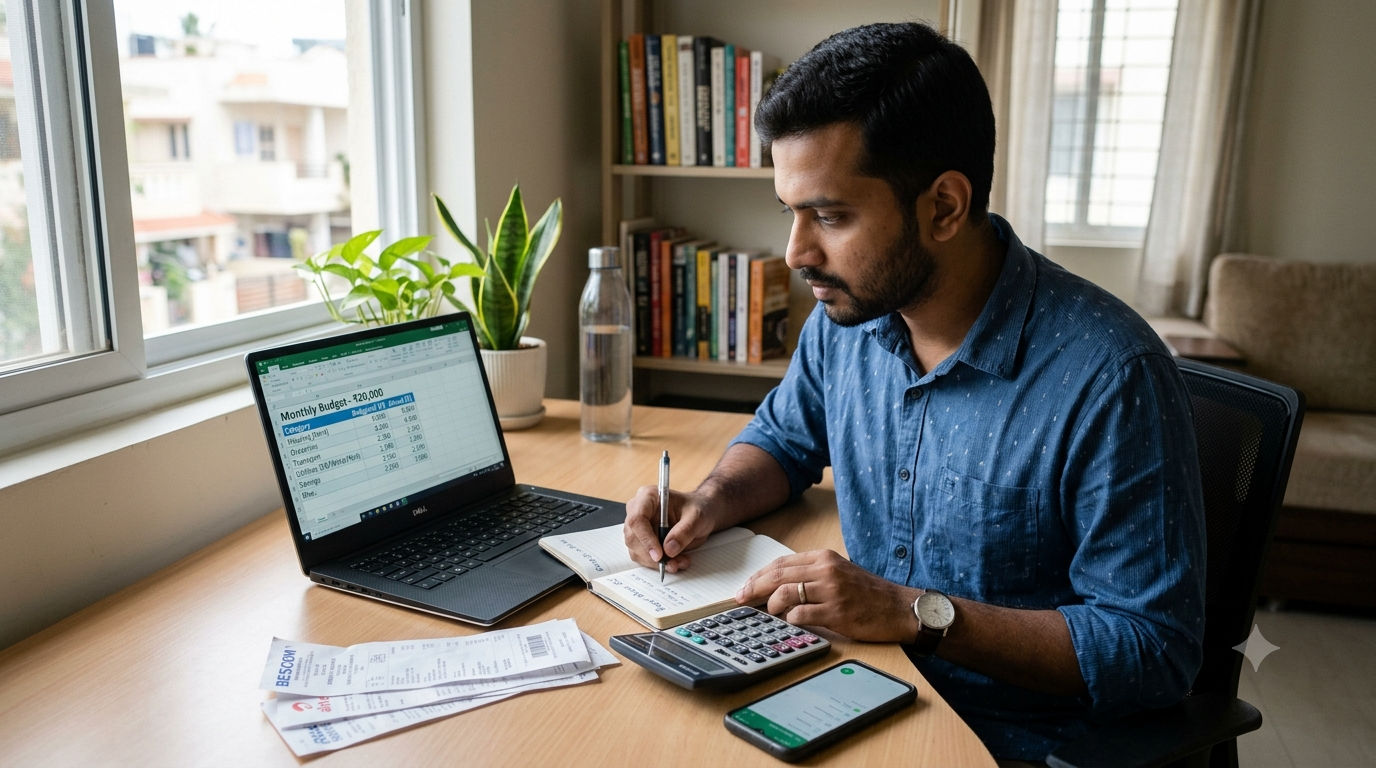
Managing ₹20,000 a month can feel difficult when rent, groceries, transport, mobile bills and unexpected expenses all compete for the same salary.
A practical monthly budget for 20000 salary should first cover essential living costs, then reserve money for savings and emergencies, and finally allocate a reasonable amount for personal spending.
For example, someone earning ₹20,000 take-home per month could start with ₹6,000 for housing, ₹4,000 for food, ₹2,000 for transport, ₹1,500 for utilities, ₹3,000 for savings and emergencies, and ₹3,500 for personal expenses and a buffer.
This is an example rather than a universal rule. Your actual budget should change according to where you live, your rent, family responsibilities, existing EMIs and lifestyle.
SEBI’s investor-education guidance recommends creating a budget, tracking expenses, prioritising basic needs before wants, allocating money regularly toward savings and investments, and building an emergency fund.
Table of Contents
Monthly Budget for 20000 Salary: A Practical Example
Here is a simple starting budget for someone with a ₹20,000 monthly take-home income.
| Category | Monthly Amount | % of Salary |
|---|---|---|
| Rent / Housing | ₹6,000 | 30% |
| Groceries & Food | ₹4,000 | 20% |
| Transport | ₹2,000 | 10% |
| Utilities & Mobile | ₹1,500 | 7.5% |
| Emergency Fund & Savings | ₹3,000 | 15% |
| Personal / Healthcare | ₹1,500 | 7.5% |
| Entertainment / Flexible Spending | ₹1,000 | 5% |
| Buffer | ₹1,000 | 5% |
| Total | ₹20,000 | 100% |
This allocation is an illustrative budget, not a ratio prescribed by RBI or SEBI.
Its biggest advantage is simplicity: every rupee has a purpose before the month begins.
The ₹1,000 buffer is particularly useful because actual monthly expenses rarely follow a spreadsheet perfectly. Medicine, vehicle repairs, family obligations or a higher-than-usual electricity bill can otherwise force you to borrow or take money from savings.
Step 1: Start With Your Take-Home Salary
Your budget should begin with the money actually available to spend each month.
If ₹20,000 is your take-home salary, the basic equation is:
₹20,000 income − monthly expenses = monthly surplus
RBI financial-literacy material describes budgeting as balancing income and expenses so expenses remain below income and the surplus can be used for future needs.
This sounds simple, but budgeting often fails because people estimate expenses instead of recording them.
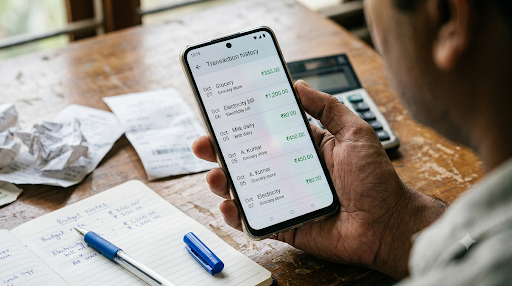
Review your previous one to three months of bank statements, UPI transactions and cash spending.
Separate your expenses into categories such as:
- Rent
- Groceries
- Electricity
- Mobile and internet
- Transport
- Medicine
- EMIs
- Eating out
- Subscriptions
- Shopping
- Entertainment
Once you know where your ₹20,000 currently goes, deciding what needs to change becomes much easier.
Step 2: Keep Housing Costs Under Control
In the example budget, housing receives ₹6,000, or 30% of take-home salary.
That does not mean everyone earning ₹20,000 should spend exactly ₹6,000 on rent.
Someone living with family may pay much less. Someone working in an expensive neighbourhood may struggle to find suitable accommodation at that level.
The important issue is what high rent does to the rest of your budget.
Suppose your rent increases from ₹6,000 to ₹9,000.
That additional ₹3,000 must come from somewhere else—food, transport, savings, discretionary spending or additional income.
For workers earning ₹20,000, sharing accommodation, choosing a more affordable area where practical, or reducing housing costs can have a much bigger financial impact than cutting tiny daily purchases.
What If Your Rent Is Already ₹8,000–₹10,000?
Don’t force yourself to follow the example budget.
Instead, rebuild the budget around your actual housing cost.
Start by protecting:
- Housing
- Basic food
- Necessary transport
- Utilities
- Healthcare and essential obligations
Then determine what can realistically go toward savings and discretionary spending.
Step 3: Set a Realistic Food Budget
The example allocates ₹4,000 per month for groceries and food.
That works out to roughly ₹133 per day on average over a 30-day month, although food spending will not occur in equal daily amounts.
Cooking most meals at home can make this target more achievable for a single person in some circumstances.
Frequent food delivery can change the equation quickly.
For example, an additional ₹150 spent on food three times per week equals roughly ₹1,800 over four weeks.
The objective is not to eliminate every enjoyable meal.
It is to understand how much convenience spending costs over an entire month.
SEBI distinguishes needs such as food and housing from wants such as dining out and entertainment, and recommends prioritising needs while maintaining a focus on savings.
Step 4: Put Savings Into the Budget
One of the easiest mistakes on a ₹20,000 salary is following this approach:
Salary → Spend → Save whatever remains
Often, very little remains.
Instead, give savings their own budget category.
Our example allocates:
₹3,000 per month to savings and the emergency fund.
If maintained for 12 months without withdrawals:
₹3,000 × 12 = ₹36,000
This calculation does not include interest or investment returns.
If ₹3,000 is currently impossible, don’t treat that as a reason to save nothing.
You could begin with ₹500, ₹1,000 or another sustainable amount and increase it as your financial situation improves.
SEBI’s guidance recommends allocating a portion of income regularly toward savings and investments while building an emergency fund for unexpected financial setbacks.
[INTERNAL LINK: How to Save Money on a Low Salary]
Step 5: Build an Emergency Fund Gradually
An emergency fund is different from money saved for shopping, travel or entertainment.
It exists for unexpected financial problems.
Examples include:
- Urgent medical expenses
- Essential repairs
- Temporary income loss
- Unexpected necessary travel
- Other unavoidable financial emergencies
RBI financial-education material says it is generally recommended to maintain an emergency fund covering at least three months of living expenses. It also notes that people who cannot fund the full amount immediately can start small and contribute from each paycheck.
Suppose your essential expenses are ₹15,000 per month.
A three-month target would be:
₹15,000 × 3 = ₹45,000
You do not need ₹45,000 immediately.
If you put ₹2,000 per month toward this target, ignoring interest, you would accumulate:
- 3 months: ₹6,000
- 6 months: ₹12,000
- 12 months: ₹24,000
- 18 months: ₹36,000
- About 23 months: ₹46,000
The important habit is consistent progress.
[INTERNAL LINK: How to Build an Emergency Fund on a Low Salary]
Step 6: Control Small but Repeated Expenses
A ₹50 purchase may not look important.
But frequency matters.
₹50 spent every working day for 22 days becomes:
₹1,100 per month
₹100 spent five times per week for four weeks becomes:
₹2,000 per month
For someone earning ₹20,000, that second example represents 10% of monthly take-home income.
This doesn’t mean every small pleasure needs to disappear.
Instead, identify spending that happens repeatedly without providing much value.
RBI financial-education material recommends examining expenses as needs, wants or waste, then eliminating waste and trimming wants to improve monthly savings.
A simple weekly review of UPI and bank transactions can reveal recurring expenses that are easy to overlook.
Step 7: Use a Weekly Spending Limit
A monthly budget can feel abstract.
A weekly limit makes it easier to manage.
Suppose your flexible spending categories total ₹4,000 after fixed expenses and planned savings.
Instead of viewing that as ₹4,000 available at once, you could work with roughly:
₹1,000 per week
This creates a natural checkpoint.
If you spend ₹1,800 during the first week, you immediately know that later weeks need adjustment instead of discovering the problem just before payday.
What About the 50/30/20 Budget Rule?
You may have seen the 50/30/20 budgeting framework:
- 50% for needs
- 30% for wants
- 20% for savings
Applied mechanically to ₹20,000, that would mean:
- ₹10,000 for needs
- ₹6,000 for wants
- ₹4,000 for savings
But fixed percentages do not automatically fit every low-income household.
Rent, commuting and food alone may exceed ₹10,000.
Someone supporting parents or paying an unavoidable EMI may have even less flexibility.
For that reason, percentage rules are better treated as planning references rather than strict requirements.
Your actual budget should reflect your real essential expenses.
What If You Have an EMI?
Debt changes the budget.
An EMI should be treated as an existing financial obligation rather than ignored while creating an idealised budget.
For example, someone with a ₹3,000 EMI might need to temporarily reduce entertainment, discretionary spending or other flexible categories.
SEBI advises borrowers to assess their repayment capacity, make repayments on time and in full, regularly review borrowing and avoid excessive debt.
Do not take a new loan simply to maintain discretionary spending.
[INTERNAL LINK: How to Manage Salary When You Have Multiple EMIs]
Sample ₹20,000 Budget for Someone Living With Family
Housing circumstances can dramatically change your budget.
Consider this illustrative alternative:
| Category | Amount |
|---|---|
| Family Contribution | ₹4,000 |
| Food / Groceries | ₹3,000 |
| Transport | ₹2,000 |
| Mobile / Utilities | ₹1,000 |
| Savings | ₹4,000 |
| Emergency Fund | ₹2,000 |
| Personal / Healthcare | ₹1,500 |
| Entertainment | ₹1,000 |
| Skill Development | ₹500 |
| Buffer | ₹1,000 |
| Total | ₹20,000 |
Here, lower housing costs allow ₹6,000 to go toward savings and the emergency fund.
This demonstrates why copying somebody else’s budget percentage can be misleading.
Sample ₹20,000 Budget With Higher Rent
Now consider someone paying ₹8,000 in rent.
| Category | Amount |
|---|---|
| Rent | ₹8,000 |
| Food | ₹4,000 |
| Transport | ₹2,000 |
| Utilities | ₹1,000 |
| Savings / Emergency Fund | ₹2,000 |
| Personal / Healthcare | ₹1,000 |
| Entertainment | ₹500 |
| Buffer | ₹1,500 |
| Total | ₹20,000 |
Savings fall because housing consumes a larger portion of income.
If rent and other essentials consistently leave almost no surplus, expense cutting has limits.
At that point, improving income through a better-paying role, additional skills, overtime where appropriate or legitimate side income may have a larger long-term impact than repeatedly cutting essential expenses.
Common Budgeting Mistakes on a ₹20,000 Salary
1. Saving Only What Remains
If savings are always last, other spending can consume the entire salary.
Give savings a defined place in your budget, even if the initial amount is small.
2. Ignoring Irregular Expenses
Festival spending, repairs, annual fees, clothing and medical costs may not occur every month.
But they still exist.
Setting aside a small amount each month can prevent these predictable but irregular expenses from damaging your budget later.
3. Treating Every Want as a Need
SEBI’s educational material distinguishes essential needs from lifestyle-enhancing wants and larger desires.
That distinction becomes particularly important when income is limited.
4. Depending on Credit for Routine Expenses
Repeatedly borrowing for ordinary living expenses can create another fixed obligation next month.
SEBI cautions against borrowing for avoidable or unnecessary expenses and advises borrowers to consider repayment capacity before taking a loan.
5. Making Your Budget Too Strict
A budget that leaves absolutely no room for personal spending can be difficult to maintain.
A small entertainment or flexible-spending category can make the plan more realistic without sacrificing essential financial goals.
A Simple Payday System for a ₹20,000 Salary
When your ₹20,000 salary arrives, divide it by purpose rather than leaving the entire amount available for general spending.
Using our main example:
₹20,000 Salary
→ ₹6,000 Housing
→ ₹4,000 Food
→ ₹2,000 Transport
→ ₹1,500 Utilities
→ ₹3,000 Savings/Emergency Fund
→ ₹1,500 Personal/Healthcare
→ ₹1,000 Entertainment
→ ₹1,000 Buffer
You can adapt this system using separate account balances, savings buckets or a simple budgeting spreadsheet.
The method matters less than knowing how much money remains in each category.
How to Improve Your Budget Over the Next 90 Days
Don’t try to create the perfect budget overnight.
Month 1: Track
Record where every meaningful expense goes.
The objective is information, not perfection.
Month 2: Adjust
Look for one or two categories that consistently exceed your plan.
Reduce low-value spending rather than randomly cutting everything.
Month 3: Automate
Once you know what amount is sustainable, consider moving planned savings away from your everyday spending balance soon after payday.
Then review your budget whenever rent, salary, debt or family responsibilities change.
SEBI’s budgeting guidance says documenting income and expenses can help control spending, save money, pay debt and work toward financial goals.
How Much Should You Save From a ₹20,000 Salary?
There is no single savings amount that works for every ₹20,000 earner.
In our main example, the target is ₹3,000 per month, or 15% of take-home salary.
But your sustainable amount could be different.
If you can currently save only ₹1,000 consistently, that may be more useful than setting an unrealistic ₹4,000 target and abandoning the budget.
As income increases or fixed costs decline, consider increasing savings before expanding lifestyle spending.
Practical Takeaway
A good monthly budget for 20000 salary is not the one with the most impressive savings percentage.
It is the one you can actually follow.
Start with your real take-home salary, protect essential expenses, control housing and recurring discretionary costs, create a specific savings category and gradually build an emergency fund.
Most importantly, track what actually happens.
Your first budget is a plan.
Your spending record tells you whether that plan works.
Frequently Asked Questions
Is ₹20,000 Salary Enough to Save Money?
It can be possible to save from a ₹20,000 salary if essential expenses leave a surplus. The amount depends heavily on rent, transport, family responsibilities, debt and other fixed costs. Even a modest but consistent saving can be a useful starting point.
How Much Should I Save From a ₹20,000 Salary?
There is no official percentage that everyone must follow. This article’s example sets aside ₹3,000, or 15%, but someone with higher essential expenses may need to start with a smaller amount.
How Can I Manage a ₹20,000 Salary With Rent?
Start with actual rent, food, essential transport, utilities and unavoidable obligations. Then assign a realistic amount to savings before setting your discretionary-spending limit.
How Can I Save ₹5,000 From a ₹20,000 Salary?
Saving ₹5,000 means living on the remaining ₹15,000. Whether that is realistic depends on your fixed costs. Lower housing costs, shared accommodation, reduced discretionary spending or living with family could make the target easier, but essential needs should remain adequately funded.
Should I Invest If My Salary Is Only ₹20,000?
Before choosing investments, consider your essential expenses, emergency savings, debt and financial goals. SEBI recommends budgeting, allocating money toward savings and investments, and maintaining an emergency fund as part of managing income and expenses.
How Large Should My Emergency Fund Be?
RBI financial-education material says an emergency fund covering at least three months of living expenses is generally recommended. If that target currently seems too large, starting with a smaller amount and contributing regularly can make the goal more manageable.