An emergency fund for family in India should generally cover at least three to six months of essential household expenses. Families with irregular income, a single earning member, elderly dependants or significant financial obligations may prefer a larger cushion of six to twelve months.
For example, if your family spends ₹40,000 every month on essential needs, a six-month emergency fund would be ₹2,40,000. A twelve-month reserve would be ₹4,80,000.
The right amount depends on your household’s expenses, income security and responsibilities—not simply your monthly salary.
Table of Contents

What Is an Emergency Fund for Family in India?
An emergency fund is money set aside to manage unexpected expenses or temporary income loss without immediately relying on loans, credit cards or long-term investments.
The Reserve Bank of India’s financial education material recommends maintaining at least three months of living expenses and suggests six months or more for people with less secure employment or self-employment.
For families, this reserve may be particularly valuable when several people depend on one or two incomes.
Typical emergencies include:
- Sudden job loss or salary interruption.
- Urgent medical expenses not fully covered by insurance.
- Essential home or vehicle repairs.
- Unexpected travel for a family emergency.
- Temporary loss of business or freelance income.
An emergency fund is not intended for vacations, festival shopping, routine school fees or planned purchases. These should ideally have separate savings.
How Much Emergency Fund Does a Family Need in India?
A useful starting point is three to six months of essential family expenses. Some households should consider a larger reserve based on the consequences of losing income.
| Family Situation | Suggested Starting Target |
|---|---|
| Two stable incomes, few dependants | 3–6 months |
| Single-income salaried family | 6 months |
| Family with children or elderly dependants | 6–9 months |
| Freelancer or self-employed household | 6–12 months |
| Irregular income and major loan commitments | 9–12 months |
These are practical planning ranges, not mandatory regulatory requirements. They should be adjusted for job security, access to support, insurance and financial obligations.
A household with two independent, stable incomes may need a different reserve from a family where one salary supports four people.
Why Six Months Is a Useful Family Savings Target
Six months provides more breathing room than a small emergency reserve when income suddenly stops.
For instance, a family spending ₹35,000 on essentials every month would need ₹2,10,000 to cover six months of those costs.
That does not mean every family must save the full amount immediately. Building one month’s expenses first and increasing the reserve gradually is a sensible approach.
Family Emergency Fund Calculator: Step-by-Step
Use this formula:
Emergency Fund = Essential Monthly Family Expenses × Number of Months of Protection
Step 1: Identify Essential Monthly Expenses
Include costs that must continue even during a financial emergency.
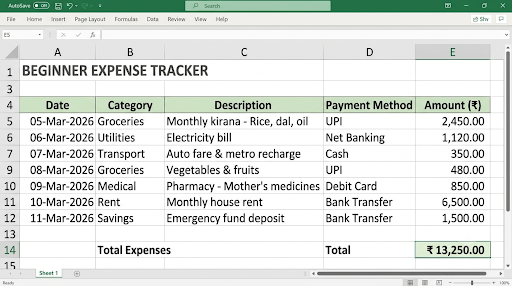
Consider the following illustrative family budget:
| Essential Expense | Monthly Amount |
|---|---|
| Rent | ₹12,000 |
| Groceries and household supplies | ₹9,000 |
| Electricity, water and cooking gas | ₹3,000 |
| School and essential education expenses | ₹4,000 |
| Transport | ₹3,000 |
| Insurance and regular medical needs | ₹2,000 |
| Loan EMIs | ₹5,000 |
| Phone and internet | ₹2,000 |
| Total | ₹40,000 |
This example is hypothetical. Actual costs differ across cities, family sizes and lifestyles.
Include unavoidable annual expenses by converting them into monthly equivalents. For example, a necessary annual payment of ₹12,000 adds ₹1,000 to your monthly calculation.
Avoid double-counting annual costs already included in monthly estimates.
Step 2: Choose Your Protection Period
For the illustrative ₹40,000 monthly budget:
| Coverage | Emergency Fund Needed |
|---|---|
| 3 months | ₹1,20,000 |
| 6 months | ₹2,40,000 |
| 9 months | ₹3,60,000 |
| 12 months | ₹4,80,000 |
A six-month target of ₹2,40,000 can be a reasonable starting goal for this example family. The ideal amount could be higher or lower depending on circumstances.
Step 3: Subtract Existing Emergency Savings
Suppose your family already has ₹60,000 specifically reserved for emergencies.
Six-month target: ₹2,40,000
Existing emergency savings: ₹60,000
Remaining savings required: ₹1,80,000
Do not automatically count retirement investments, equity holdings or money earmarked for school fees as available emergency savings.
Step 4: Calculate Your Monthly Contribution
If the remaining target is ₹1,80,000:
- Saving ₹5,000 monthly takes 36 months.
- Saving ₹7,500 monthly takes 24 months.
- Saving ₹10,000 monthly takes 18 months.
These calculations assume no interest, withdrawals or changes in expenses.
Choose a contribution you can maintain without missing essential payments.
Emergency Fund Examples for Different Family Budgets
Here are illustrative targets based on essential monthly expenses rather than income.
| Monthly Essentials | 3 Months | 6 Months | 12 Months |
|---|---|---|---|
| ₹20,000 | ₹60,000 | ₹1,20,000 | ₹2,40,000 |
| ₹30,000 | ₹90,000 | ₹1,80,000 | ₹3,60,000 |
| ₹40,000 | ₹1,20,000 | ₹2,40,000 | ₹4,80,000 |
| ₹50,000 | ₹1,50,000 | ₹3,00,000 | ₹6,00,000 |
| ₹75,000 | ₹2,25,000 | ₹4,50,000 | ₹9,00,000 |
A family earning ₹70,000 and spending ₹40,000 on essential needs does not necessarily need six months of its entire ₹70,000 income.
The calculation should primarily reflect what the family must spend to maintain essential commitments during an emergency.
However, if the household has major irregular expenses or dependants with additional needs, the basic calculation may need an extra cushion.
How to Build a Family Emergency Fund on a Limited Salary
Building emergency savings is possible through gradual contributions, even when a household cannot set aside a large amount immediately.
1. Start With a Small First Milestone
Instead of focusing only on a ₹3 lakh target, begin with ₹10,000 or another manageable amount.
Next, work towards one month of essential expenses, followed by three months and eventually your full target.
This approach creates visible progress.
2. Create a Separate Emergency Savings Account
Keep emergency savings separate from your normal spending account.
This makes the balance easier to track and reduces the temptation to use it for everyday purchases.
RBI financial education material also recommends keeping emergency savings in an easily accessible separate savings account.
3. Automate Monthly Transfers
Schedule a transfer soon after receiving your salary.
For example, saving ₹4,000 every month would accumulate ₹48,000 in one year, excluding interest.
Even a modest recurring contribution can build a useful first layer of protection.
4. Reduce Spending That Is Not Essential
Review subscriptions, frequent food deliveries, impulse shopping and other discretionary expenses.
Redirect some of the savings to the emergency fund without cutting essential nutrition, healthcare or education.
[INTERNAL LINK: Monthly Expense Tracker in Excel for Beginners]
5. Use Unexpected Income Carefully
Bonuses, refunds and additional freelance income can accelerate your progress.
Decide in advance what portion will go towards your emergency savings.
6. Replenish the Fund After Using It
An emergency withdrawal is not a failure. It is the purpose of the fund.
Once household finances stabilise, restart contributions until the target is restored.
[INTERNAL LINK: How to Build an Emergency Fund in India]
Where Should a Family Keep Its Emergency Fund in India?
The primary goals are safety, accessibility and stability—not maximising investment returns.
Savings Bank Account
A separate savings account at an insured bank is a straightforward option for money that may be required immediately.
It generally offers convenient access through bank transfers, ATMs or other supported withdrawal channels.
Bank Fixed Deposits
A bank fixed deposit may be suitable for part of the reserve, provided you understand premature withdrawal rules, penalties and access limitations.
Consider dividing the reserve between immediately accessible savings and deposits that can be broken when needed.
Liquid Mutual Funds
Liquid mutual funds may be considered for a portion of a larger reserve by households that understand their risks.
However, they are not bank deposits, returns are not guaranteed, and redemption may not provide instant access in every circumstance.
They also do not receive DICGC deposit insurance.
A family that prioritises certainty and immediate access may prefer to keep its core emergency reserve in bank deposits.
Understand Deposit Insurance
India’s Deposit Insurance and Credit Guarantee Corporation (DICGC) insures eligible deposits up to ₹5 lakh per depositor per insured bank, including principal and interest, for deposits held in the same right and capacity.
Different accounts or branches of the same bank do not automatically create separate ₹5 lakh limits.
The insurance limit should be considered when keeping substantial family savings in bank deposits.
[EXTERNAL LINK — DOFOLLOW: DICGC guide to deposit insurance → https://www.dicgc.org.in/guide-to-deposit-insurance]
Should Families With Children or Elderly Parents Save More?
Families with additional dependants may benefit from a larger emergency reserve.
School-related obligations, medical needs and the difficulty of reducing household spending quickly can make income disruption more expensive.
Consider a family with two children, one earning member and a monthly essential budget of ₹50,000.
A six-month reserve would be ₹3,00,000, while a nine-month reserve would be ₹4,50,000.
The larger figure may be appropriate if employment is uncertain or replacing the income would take time.
Insurance remains important, but it does not replace emergency cash. Policies have exclusions, deductibles, limits and claim procedures.
The emergency fund can help with expenses that insurance does not immediately cover.
Emergency Fund vs Health Insurance vs Investments
These three tools serve different purposes.
| Financial Tool | Main Purpose |
|---|---|
| Emergency fund | Immediate financial support during unexpected disruption |
| Health insurance | Coverage for eligible medical expenses under policy terms |
| Long-term investments | Building wealth for future goals |
A family should not assume that equity mutual funds or stocks will be available at a favourable price during an emergency.
Selling investments during a market downturn can lock in losses.
Similarly, a credit card is not a replacement for emergency savings because borrowing creates repayment obligations and may incur high interest charges.
Seven Common Emergency Fund Mistakes Families Should Avoid
1. Calculating Savings From Salary Alone
Your fund should be based on essential expenses, not a fixed percentage of gross salary.
2. Forgetting Loan EMIs
Home, vehicle and other unavoidable loan payments may continue after income stops.
3. Counting Money Already Reserved for Other Goals
School fees, annual insurance premiums and upcoming major purchases should have their own budgets.
4. Keeping Everything in Risky Investments
Emergency savings should not depend on stock market performance or speculative assets.
5. Ignoring Access Restrictions
Check withdrawal availability, bank transfer limits and deposit-breaking conditions before an emergency occurs.
6. Using the Fund for Non-Emergencies
A discounted smartphone or holiday offer is not an unexpected financial crisis.
7. Never Updating the Target
Review the amount after a change in rent, family size, loan obligations, employment or essential living costs.
A Practical 12-Month Family Emergency Fund Plan
Suppose a family can consistently save ₹6,000 each month.
| Month | Total Saved |
|---|---|
| 1 | ₹6,000 |
| 3 | ₹18,000 |
| 6 | ₹36,000 |
| 9 | ₹54,000 |
| 12 | ₹72,000 |
These are illustrative contributions, excluding interest and withdrawals.
For a family with ₹30,000 in essential monthly expenses, ₹72,000 would cover approximately 2.4 months.
That family could continue saving until it reaches a three-month target of ₹90,000 and then work towards a six-month target of ₹1,80,000.
If the household cannot manage ₹6,000 monthly, a smaller contribution is still worthwhile.
[INTERNAL LINK: How to Save Money on a ₹25,000 Salary]
When Should You Increase Your Emergency Fund?
Recalculate your reserve when:
- Your household becomes dependent on one income.
- You move to a city with higher living expenses.
- You have a child or take responsibility for another dependant.
- Your monthly EMI obligations increase.
- Your income becomes irregular.
- Your insurance protection changes.
- Your family faces a prolonged period of employment uncertainty.
A useful review frequency is once or twice a year, or whenever there is a major change in family finances.
Practical Takeaway: Build Security Before Chasing Returns
An emergency fund is not designed to make your family wealthy. It is designed to give your household financial breathing room when something goes wrong.
Start by identifying essential expenses, selecting an appropriate number of months and calculating your target.
Keep the money accessible, save consistently and avoid using it for planned spending.
For many Indian families, six months of essential expenses is a useful goal. Those with greater income uncertainty or more dependants may need additional protection.
Conclusion
The right emergency fund for family in India depends on essential household expenses, income stability and the number of people relying on that income.
If your family needs ₹40,000 monthly to cover essentials, a six-month reserve is ₹2,40,000. If your situation calls for twelve months of protection, the target becomes ₹4,80,000.
You do not have to build the entire fund overnight. Start with a manageable amount, reach your first month of expenses and gradually increase your protection.
A well-maintained emergency fund helps your family handle financial setbacks without immediately compromising essential needs or long-term goals.
Frequently Asked Questions
1. How much emergency fund is enough for a family in India?
A family should generally aim for 3–6 months of essential household expenses. Families with irregular income, a single earning member or greater financial responsibilities may consider 6–12 months. For example, a family spending ₹30,000 monthly would need ₹1,80,000 for six months.
2. Is ₹1 lakh enough for a family emergency fund?
It depends on monthly expenses. If essential family expenses are ₹20,000, ₹1 lakh covers five months. If expenses are ₹50,000, the same amount covers only two months. Calculate your target based on actual household needs.
3. Should an emergency fund be based on salary or expenses?
An emergency fund should primarily be based on essential monthly expenses, including rent, groceries, utilities, insurance, transport and unavoidable loan payments. Salary determines how quickly you can build the fund, but expenses determine how much protection you need.
4. Where should a family keep emergency savings in India?
A separate savings bank account at an insured bank is a practical starting point. Some families may keep part of their reserve in prematurely withdrawable bank fixed deposits. Accessibility, capital protection and withdrawal conditions should take priority over returns.
5. Does a family with health insurance still need an emergency fund?
Yes. Health insurance covers eligible medical costs under policy conditions, while emergency savings can help with job loss, household repairs, uncovered expenses and other urgent financial needs.
6. How can a family build an emergency fund with a low salary?
Start with a manageable amount, such as ₹1,000–₹3,000 monthly if affordable. Track essential spending, reduce avoidable expenses, automate savings and gradually work towards one month, three months and eventually six months of essential expenses. Consistency matters more than a large initial deposit.