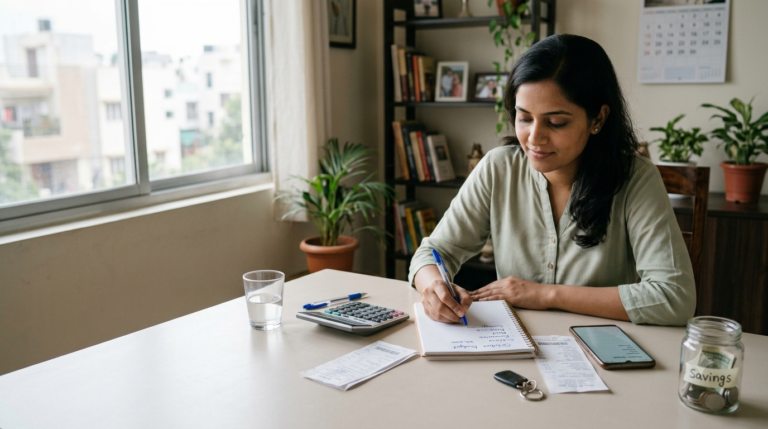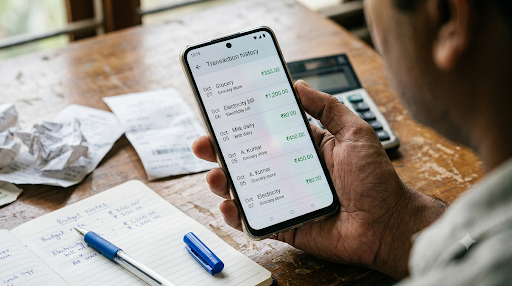
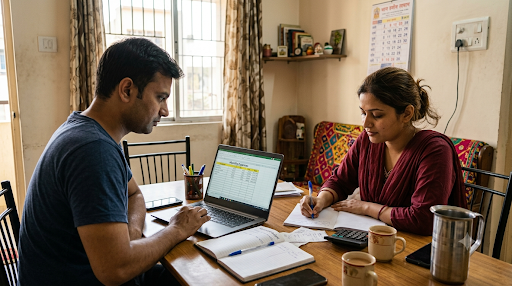
Managing a ₹20,000 monthly salary can feel difficult when rent, groceries, transportation, mobile bills, and unexpected expenses all compete for the same money.
You receive your salary at the beginning of the month. You pay your bills, buy groceries, recharge your phone, and make a few small purchases. Before you realise it, your bank balance is much lower than expected.
The problem is not always a lack of discipline. Sometimes, it is simply a lack of visibility into where your money goes.
That is why expense tracking for 20000 salary can be a useful habit. By recording your spending, planning essential expenses, and reviewing your budget regularly, you can make more informed decisions about your money.
In this guide, you will learn how to create a realistic ₹20,000 salary budget, track everyday expenses, identify unnecessary spending, and start saving even when your income is limited.
Table of Contents
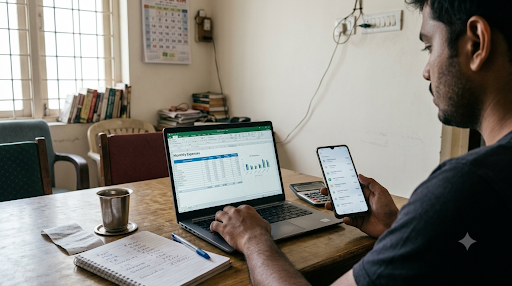
Why Expense Tracking Matters on a ₹20,000 Salary
When your income is ₹20,000 per month, even small expenses can affect your financial stability.
For example, spending ₹100 unnecessarily every day adds up to approximately ₹3,000 over 30 days. That represents 15% of a ₹20,000 monthly salary.
Without tracking, these purchases can easily go unnoticed.
A simple expense tracking system helps you:
- Understand where your salary is being spent.
- Separate essential expenses from optional purchases.
- Identify recurring costs that can be reduced.
- Avoid running short of money before payday.
- Plan for annual bills and unexpected expenses.
- Build a realistic monthly savings habit.
Expense tracking does not mean eliminating every enjoyable purchase. It means understanding your priorities and making spending decisions consciously.
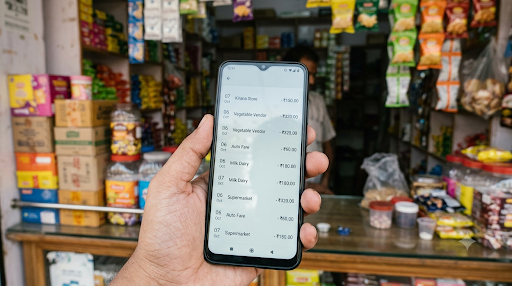
Step 1: Calculate Your Actual Monthly Take-Home Salary
Before preparing a budget, identify the amount of money that actually reaches your bank account.
Your take-home salary may be different from your gross salary because of deductions such as provident fund contributions, professional tax, or other payroll deductions.
For this example, we will assume that ₹20,000 is your monthly take-home salary.
| Income Details | Amount |
|---|---|
| Monthly take-home salary | ₹20,000 |
| Additional regular income | ₹0 |
| Total monthly income | ₹20,000 |
If ₹20,000 is your gross salary rather than your take-home salary, prepare your budget using the lower amount you actually receive.
Do not include uncertain bonuses, overtime payments, or occasional freelance earnings until that money is received.
This prevents you from planning expenses against income that may not arrive.
Step 2: Create a Realistic ₹20,000 Salary Budget Plan
A budget gives every major expense a planned limit.
The following example is designed for someone sharing accommodation or living in a relatively affordable area. It may not be realistic for someone renting independently in an expensive city.
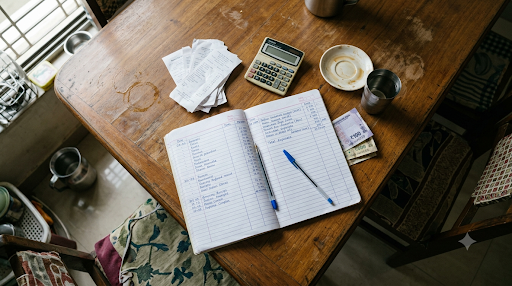
Sample Monthly Budget for ₹20,000 Salary
| Expense Category | Monthly Budget |
|---|---|
| Rent or shared accommodation | ₹5,000 |
| Groceries and food | ₹4,000 |
| Transportation | ₹1,500 |
| Electricity and utilities | ₹1,000 |
| Mobile and internet | ₹500 |
| Personal and household expenses | ₹1,500 |
| Medical and miscellaneous expenses | ₹1,000 |
| Family support or debt repayment | ₹2,000 |
| Emergency savings | ₹2,000 |
| Other savings or future goals | ₹1,500 |
| Total | ₹20,000 |
In this illustrative budget, ₹3,500 goes toward savings, which is 17.5% of take-home income.
However, this is a planning example, not a universal recommendation.
If your rent is ₹8,000, your transportation costs are higher, or you have significant debt obligations, your savings capacity may be much lower.
The purpose is to create a budget that reflects your real expenses rather than forcing your life into unrealistic numbers.
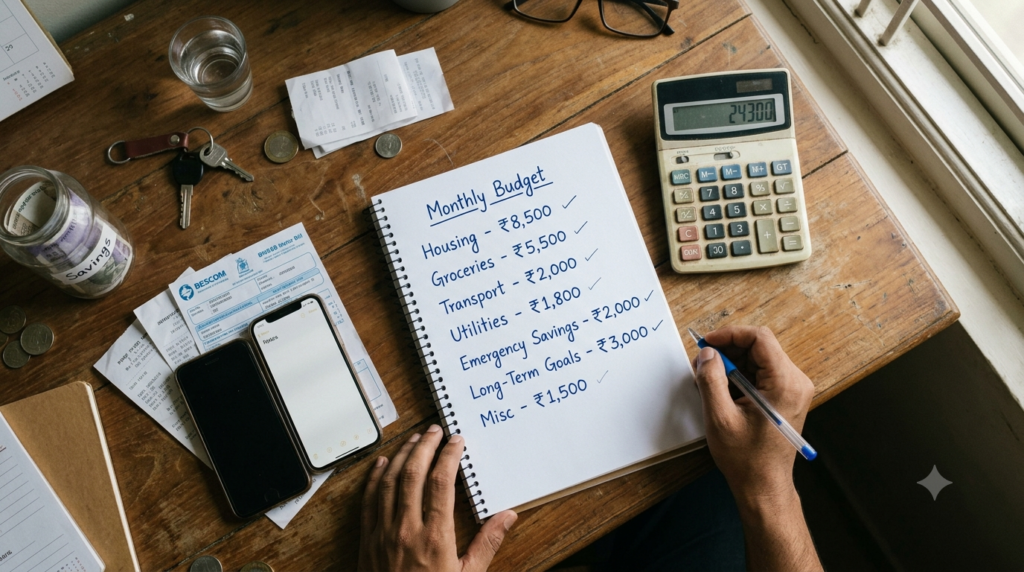
Step 3: Divide Expenses Into Four Simple Categories
A beginner-friendly approach is to group your spending into four categories.
1. Fixed Expenses
These are payments that usually remain relatively consistent each month.
Examples include rent, loan EMIs, insurance premiums, and regular family contributions.
Record these expenses first because they are often difficult to change immediately.
2. Essential Variable Expenses
These expenses are necessary, but the amounts may change.
Examples include groceries, electricity, commuting, cooking gas, and basic healthcare.
Tracking these costs helps you estimate realistic monthly averages.

3. Discretionary Expenses
These are optional purchases that can often be adjusted.
Examples include food delivery, entertainment subscriptions, frequent café visits, and impulse shopping.
You do not need to eliminate every discretionary expense. Instead, decide how much you can reasonably afford.
4. Savings and Future Expenses
This category includes emergency savings, planned purchases, and money reserved for future bills.
For example, if an annual insurance premium is ₹6,000, setting aside ₹500 each month can make that payment easier to manage.
This approach prevents predictable annual expenses from becoming last-minute financial problems.
Step 4: Start a Daily Expense Tracking Habit
Daily tracking is one of the simplest ways to understand your spending patterns.
You can use a notebook, Microsoft Excel, Google Sheets, or a basic expense tracking application.
The most important requirement is consistency.
Example Daily Expense Tracker
| Date | Expense | Category | Amount |
|---|---|---|---|
| 1 Oct | Bus fare | Transport | ₹40 |
| 1 Oct | Breakfast | Food | ₹50 |
| 1 Oct | Groceries | Groceries | ₹250 |
| 2 Oct | Mobile recharge | Mobile | ₹299 |
| 2 Oct | Tea and snacks | Personal | ₹60 |
| 3 Oct | Household supplies | Household | ₹180 |
| Total | ₹879 |
These are illustrative transactions, not actual spending data.
Recording even small purchases is important because repeated minor expenses can become substantial over a month.
For example, spending ₹40 on snacks during 25 working days adds up to ₹1,000.
Tracking makes this pattern visible, allowing you to decide whether it fits your priorities.
Step 5: Track Your ₹20,000 Salary Expenses in Excel
Microsoft Excel is useful because it allows you to organise transactions, calculate totals, and compare actual spending against your budget.
You do not need advanced Excel skills to begin.
Create Your Expense Tracker
Open a blank workbook and create the following columns:
- Column A: Date
- Column B: Description
- Column C: Category
- Column D: Payment Method
- Column E: Amount
Enter each expense as a new row.
For example, a ₹250 grocery purchase might contain the transaction date, description “Vegetables and groceries”, category “Groceries”, payment method “UPI”, and amount 250.
Calculate Total Expenses
If your expense amounts are entered in cells E2 through E100, use:
=SUM(E2:E100)
Excel will calculate the total amount recorded in that range.
Calculate Remaining Salary
If cell H2 contains your ₹20,000 take-home salary and H3 contains your total expenses, enter:
=H2-H3
This displays the amount remaining before accounting for any expenses or savings transfers not included in the transaction list.
Calculate Spending by Category
To calculate grocery expenses, use:
=SUMIF(C2:C100,"Groceries",E2:E100)
This formula adds the amounts for transactions labelled “Groceries”.
You can create similar formulas for rent, transport, utilities, and other categories.
For more detailed instructions, read our guide to creating a monthly expense tracker in Excel for beginners.
Step 6: Use a Practical Budgeting Rule
You may have heard about the popular 50/30/20 budgeting rule.
It divides take-home income into:
- 50% for needs.
- 30% for wants.
- 20% for savings and eligible debt repayment.
For a ₹20,000 salary, that would mean ₹10,000 for needs, ₹6,000 for wants, and ₹4,000 for savings and eligible debt repayment.
However, this division may be unrealistic for people with high rent, essential family responsibilities, or expensive commutes.
A better approach is to treat budgeting percentages as guidelines rather than strict requirements.
Start by calculating your essential expenses. Then account for minimum debt payments and other unavoidable commitments.
Use the remaining amount for reasonable discretionary spending, emergency savings, and future goals.
If you can save only ₹500 initially, that is still a meaningful starting point, provided your essential obligations are covered.
Increase the amount when your circumstances allow.
Step 7: Identify Small Expenses That Reduce Your Savings
Small purchases can quietly reduce the money available for savings.
Consider this example:
| Spending Habit | Monthly Cost |
|---|---|
| Snacks: ₹40 × 25 days | ₹1,000 |
| Food delivery: ₹200 × 4 orders | ₹800 |
| Extra subscriptions | ₹300 |
| Impulse purchases | ₹500 |
| Total | ₹2,600 |
These expenses are not automatically wasteful.
However, reviewing them can reveal opportunities to spend less without significantly reducing your quality of life.
For example, reducing food delivery from four orders to two could save ₹400 in this scenario.
Cancelling an unused ₹300 subscription could create additional savings.
The goal is to remove spending that provides little value, not to make your budget unnecessarily restrictive.
Step 8: Set a Weekly Spending Limit
Monthly budgets can be difficult to follow because payday and month-end are far apart.
Weekly limits make spending easier to monitor.
Suppose your budget allows ₹4,000 for groceries and food.
Dividing this amount across four planning periods gives a target of ₹1,000 per period.
For greater accuracy, you can use a daily average of approximately ₹133 over a 30-day month.
Weekly limits are useful, but they should remain flexible.
Some grocery purchases cover several days, and certain weeks naturally cost more than others.
Review your spending against the monthly target instead of treating every weekly variation as a failure.
Step 9: Build an Emergency Fund Gradually
Unexpected expenses can disrupt a tight monthly budget.
Medical bills, urgent travel, appliance repairs, or temporary income interruptions may require money that was not included in your regular spending plan.
An emergency fund can help reduce the need to borrow for such situations.
Start with a manageable milestone, such as ₹5,000.
Then work toward covering one month of essential expenses.
Over time, you may aim for three to six months of essential expenses, depending on your job stability, dependants, and financial responsibilities.
For example, if your essential monthly expenses are ₹14,000, a three-month emergency fund would be ₹42,000.
At ₹1,000 saved per month, reaching ₹5,000 would take five months, assuming you do not need to use the money during that period.
Keep emergency savings accessible and separate from everyday spending money.
If you have expensive debt, balance emergency savings with a sensible repayment strategy.
Step 10: Review Your Expenses Every Sunday
Expense tracking becomes more useful when you review the information regularly.
Choose a consistent day, such as Sunday, and spend 10–15 minutes reviewing your transactions.
Ask yourself:
- How much money did I spend this week?
- Which category consumed the most money?
- Did I exceed any planned limits?
- Were there purchases I could have avoided?
- Are there bills due before my next salary?
- How much can I safely transfer to savings?
Do not use the review to criticise yourself.
Use it to identify patterns and make practical adjustments.
If transportation costs consistently exceed your budget, increase that category and reduce another category where possible.
A realistic budget is more useful than a perfect-looking budget that you cannot follow.
Step 11: Avoid Common Expense Tracking Mistakes
Tracking Only Large Expenses
Recording rent and groceries while ignoring smaller UPI payments can create an incomplete picture.
Include small transactions whenever practical.
Forgetting Cash Payments
Cash withdrawals are not necessarily expenses.
If you withdraw ₹1,000 from an ATM, record the withdrawal as a transfer between accounts or cash holdings. Record purchases separately as you spend the cash.
Otherwise, counting both the withdrawal and subsequent purchases can double-count spending.
Mixing Savings With Spending
Moving ₹2,000 from your salary account into a separate savings account is not the same as spending ₹2,000.
Track savings transfers separately so your reports distinguish consumption from money you still own.
Ignoring Irregular Expenses
Annual insurance, festival travel, vehicle servicing, and occasional medical expenses should be considered when planning your monthly budget.
Using Too Many Categories
A complicated system can become difficult to maintain.
Start with six to ten meaningful categories and expand only when necessary.
Giving Up After One Expensive Month
An unusually expensive month does not mean expense tracking has failed.
Review what happened, update your plan, and continue.
Step 12: Follow a Simple 30-Day Expense Tracking Plan
If you are beginning from scratch, try this four-week approach.
Week 1: Record Everything
Track every purchase without trying to change your habits immediately.
The goal is to understand your existing spending.
Week 2: Categorise Your Expenses
Separate fixed costs, essential variable costs, discretionary purchases, and savings.
Identify which categories consume the largest share of your income.
Week 3: Make Two Practical Adjustments
Choose two changes that are realistic for your situation.
For example, reduce unnecessary food delivery and cancel an unused subscription.
Avoid introducing too many restrictions simultaneously.
Week 4: Review and Prepare Next Month’s Budget
Compare actual spending with your planned amounts.
Update category limits, account for upcoming bills, and decide on an affordable savings target.
Repeat the process each month.
Over time, your tracker will provide a clearer picture of your actual cost of living.
Can You Save Money on a ₹20,000 Salary?
Yes, saving may be possible, but the amount depends heavily on your circumstances.
Someone living with family may have significantly lower housing costs than someone paying rent independently.
Similarly, a person supporting dependants or repaying debt may have little money left after essential expenses.
Consider three illustrative savings scenarios:
| Monthly Savings | Savings After 12 Months |
|---|---|
| ₹500 | ₹6,000 |
| ₹1,000 | ₹12,000 |
| ₹2,000 | ₹24,000 |
These calculations assume regular monthly contributions, no withdrawals, and no interest or investment returns.
If saving is currently impossible, focus first on understanding your expenses, meeting essential needs, avoiding unnecessary high-cost debt, and improving your income opportunities.
A sustainable plan is more valuable than an aggressive savings target that forces you to borrow later.
How to Make Expense Tracking Easier
The best expense tracking system is one that you can maintain.
Here are a few practical ways to simplify the process:
- Record UPI and cash purchases on the same day.
- Use consistent category names.
- Check your bank and UPI transaction history to identify missed entries.
- Keep a separate category for irregular expenses.
- Set a recurring weekly review time.
- Use Excel formulas to automate category totals.
- Adjust your budget when rent, salary, or family responsibilities change.
You can also maintain a separate savings tracker to monitor emergency fund contributions and other financial goals.
Remember that expense tracking is a tool for better decisions, not a guarantee of savings.
Final Thoughts
Expense tracking for 20000 salary is about understanding your financial reality and using your income more intentionally.
Start with your actual take-home salary, list essential commitments, and create a realistic budget based on your living costs.
Record daily expenses, review spending every week, and gradually build savings when your finances allow.
You do not need expensive budgeting software or advanced financial knowledge.
A notebook or a simple Excel spreadsheet is enough to begin.
Your first action today: Open a spreadsheet, enter your ₹20,000 monthly income, list your fixed expenses, and record your next purchase.
Small, consistent improvements can make your monthly finances easier to understand and manage.
Disclaimer: This article provides general financial education. Budget figures are illustrative and should be adjusted to your personal income, obligations, location, and financial circumstances.
Frequently Asked Questions About Expense Tracking for ₹20,000 Salary
1. How can I track expenses on a ₹20,000 salary?
Start by recording your take-home income and listing fixed expenses such as rent, utilities, and loan payments. Then record daily spending on groceries, transportation, food, and personal purchases. Use a notebook, Excel, or Google Sheets to compare your actual expenses with your monthly budget.
2. How much should I save from a ₹20,000 salary?
Your savings target depends on rent, family responsibilities, debt, and essential living costs. Saving ₹1,000 to ₹2,000 per month may be achievable for some people, while others may need to start with ₹200 to ₹500 or prioritise essential obligations first.
3. What is a good monthly budget for a ₹20,000 salary?
A realistic budget should cover housing, groceries, transportation, utilities, healthcare, and unavoidable financial commitments before discretionary spending. For example, someone paying ₹5,000 in shared accommodation may have more flexibility than someone paying ₹9,000 in rent. Adjust your category limits to your actual costs.
4. Is the 50/30/20 rule suitable for a ₹20,000 salary?
The 50/30/20 rule can be a useful starting point, but it may not fit a ₹20,000 salary when essential expenses are high. Rather than following fixed percentages, calculate your essential spending and minimum debt obligations first, then allocate the remaining money to discretionary expenses and savings.
5. Which is the best expense tracker for beginners?
A notebook, Microsoft Excel, or Google Sheets can all work well. Excel and Google Sheets are particularly useful for calculating totals, grouping spending by category, and comparing actual expenses with planned budgets. Choose whichever method you can use consistently.
6. How do I track daily UPI expenses?
Record each UPI purchase with its date, description, category, and amount. Review your UPI transaction history regularly to identify missing entries. Transfers between your own accounts should be recorded separately to avoid counting them as expenses.
7. Can I build an emergency fund with a ₹20,000 salary?
Yes, if your budget leaves room after essential expenses and debt commitments. Begin with a manageable amount and work toward a small initial emergency fund. Over time, aim to cover several months of essential expenses according to your financial circumstances.
8. How can I reduce monthly expenses without sacrificing essential needs?
Review optional spending such as unused subscriptions, frequent food delivery, impulse purchases, and unnecessary service charges. Compare prices, plan grocery purchases, and consider lower-cost commuting options where practical. Avoid cutting necessary food, healthcare, or insurance simply to meet a savings target.
9. What Excel formula can calculate monthly expenses?
Use the SUM formula to add transaction amounts. For example, =SUM(E2:E100) calculates the total of values in that range. To calculate spending in one category, use =SUMIF(C2:C100,"Groceries",E2:E100) when column C contains categories and column E contains amounts.
10. What should I do if my ₹20,000 salary is not enough for monthly expenses?
First, identify unavoidable costs and distinguish them from optional spending. Check for opportunities to reduce recurring bills, restructure expenses, or increase income. If essential expenses exceed income, expense tracking alone cannot solve the shortfall. Prioritise necessities and seek appropriate financial guidance before taking on additional debt.