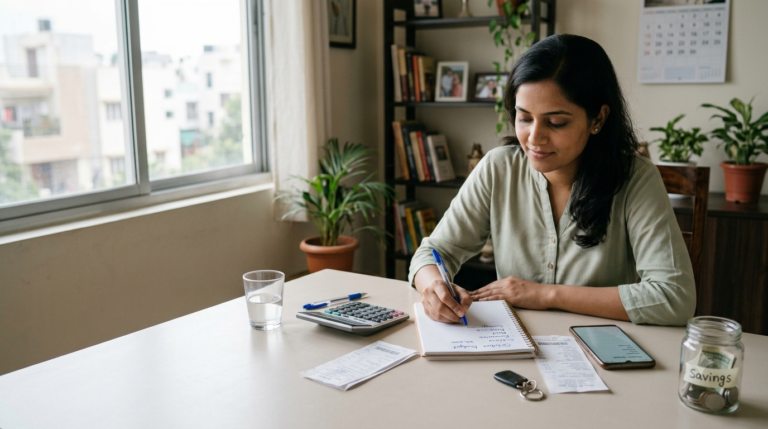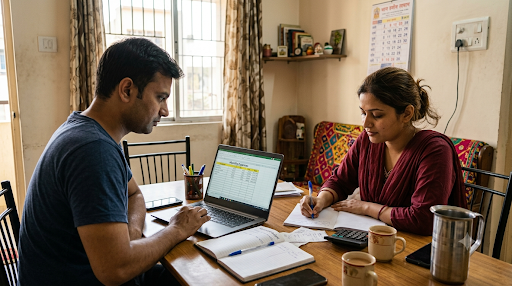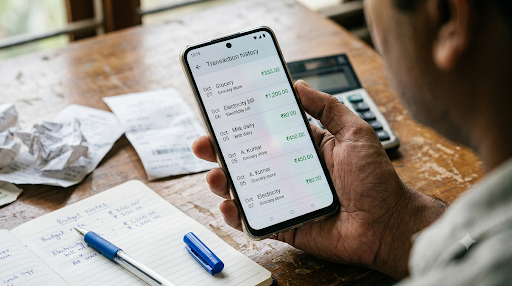

If you’re wondering how to save money on 25000 salary, the answer isn’t to stop enjoying life or cut every small expense.
The bigger difference comes from deciding where your ₹25,000 salary will go before the month begins.
For example, saving ₹3,000 consistently every month would mean setting aside ₹36,000 over 12 months. Saving ₹5,000 per month would amount to ₹60,000 over the same period.
These are simple examples, not compulsory savings targets. Your realistic amount depends on your rent, family responsibilities, debt, transportation costs and other essential expenses.
The important thing is to build a system you can follow every month.
The Reserve Bank of India describes budgeting as planning future income and expenses. Comparing your planned budget with actual spending can also help you control expenses and improve savings.
Table of Contents
How to Save Money on 25000 Salary: Start With a Realistic Budget
Before trying to reduce expenses, find out exactly where your ₹25,000 goes.
Here is one illustrative monthly budget:
Rent / Accommodation — ₹7,000
Food & Groceries — ₹4,000
Transport — ₹2,500
Utilities & Mobile — ₹1,500
Family / Personal Expenses — ₹2,000
Emergency Fund — ₹2,000
Long-Term Savings — ₹2,000
Entertainment / Miscellaneous — ₹2,000
Monthly Buffer — ₹2,000
TOTAL — ₹25,000
This is only an example.
Someone living with parents may spend considerably less on accommodation and therefore have more room to save.
Someone paying higher rent may need to reduce spending elsewhere.
There is no perfect budgeting percentage that works for everyone.
Your budget needs to reflect your real life.

1. Save Money Immediately After Salary Day
One of the biggest mistakes people make is waiting until the end of the month to save whatever remains.
Try reversing the process.
SALARY RECEIVED → SAVINGS TRANSFERRED → REMAINING MONEY SPENT
Suppose you earn ₹25,000 and decide that ₹4,000 is a realistic monthly saving target.
₹25,000 − ₹4,000 = ₹21,000
Once ₹4,000 has been moved to savings, treat ₹21,000 as your actual spending budget.
If ₹4,000 isn’t realistic, don’t force it.
Start with ₹2,000 or ₹2,500.
Saving a smaller amount consistently is generally more useful than setting an aggressive target and repeatedly withdrawing the money later.
You can also consider scheduling an automatic transfer shortly after payday so saving doesn’t depend entirely on willpower.
2. Separate Needs From Wants
When your salary is ₹25,000, every spending decision competes with another financial priority.
This makes understanding the difference between needs and wants especially useful.
Needs may include:
Rent
Basic groceries
Electricity
Transportation to work
Essential healthcare
Necessary mobile or internet expenses
Wants may include:
Frequent restaurant meals
Food delivery
Entertainment subscriptions
Fashion purchases
Expensive phone upgrades
Impulse shopping
Frequent cab rides when cheaper alternatives are practical
This doesn’t mean you should eliminate everything enjoyable.
A budget that provides absolutely no room for enjoyment can become difficult to maintain.
Instead, create a fixed monthly amount for discretionary spending.
For example, suppose you allow ₹1,500 for entertainment and eating out.
You can enjoy that money without disturbing rent, groceries or your savings target.
Once the ₹1,500 is exhausted, wait until the next budget cycle before spending more from that category.

3. Attack Your Three Biggest Expenses First
Many people focus on saving ₹10 or ₹20 at a time while ignoring expenses costing thousands every month.
Instead, identify your three biggest expense categories.
For many salaried people, they may include:
Housing
Food
Transportation
Imagine you find a realistic way to reduce one recurring expense by ₹1,000 per month.
₹1,000 × 12 months = ₹12,000
That is potentially ₹12,000 of additional room in your annual budget if the reduction is maintained.
Look for practical changes rather than extreme sacrifices.
For example:
Consider shared accommodation where appropriate.
Carry lunch to work more frequently.
Compare commuting alternatives.
Cancel subscriptions you rarely use.
Review your mobile and internet plans.
Plan grocery purchases before shopping.
Reduce unnecessary food-delivery orders.
The goal isn’t to make life uncomfortable.
The goal is to identify expenses that cost you significant money without providing equivalent value.
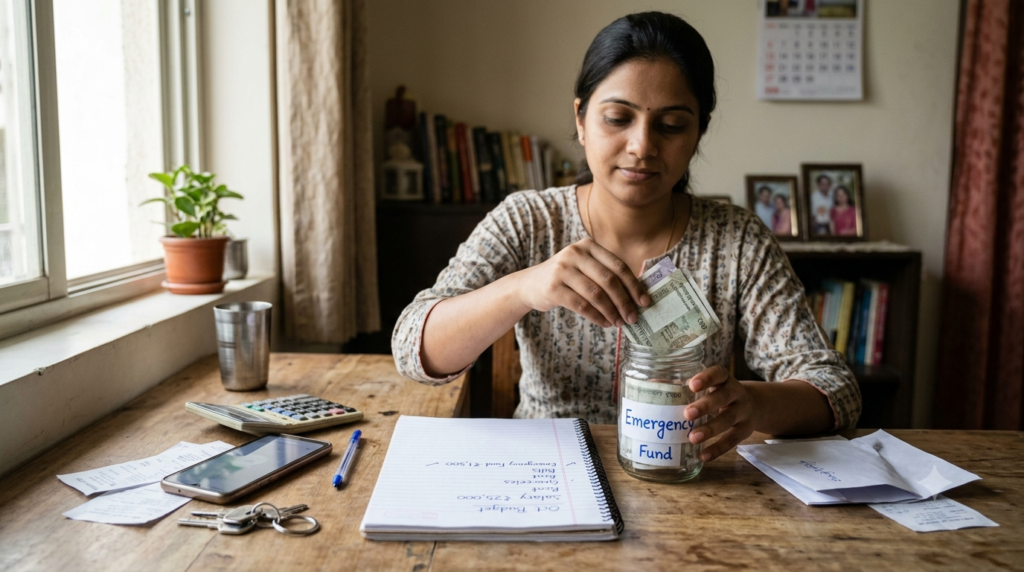
4. Build an Emergency Fund Slowly
Unexpected expenses are one of the biggest threats to a monthly budget.
You may suddenly face:
A medical expense
Urgent travel
Vehicle repair
Home repair
Temporary income interruption
Family emergency
Without emergency savings, these situations may force you to borrow money or use credit.
That’s why an emergency fund deserves its own place in your budget.
Don’t become discouraged by a large emergency-fund target.
Build it gradually.
MILESTONE 1 — ₹5,000
MILESTONE 2 — ₹10,000
MILESTONE 3 — One month of essential expenses
LONGER-TERM GOAL — Multiple months of essential expenses
For example, if you contribute ₹2,000 every month:
₹2,000 × 12 = ₹24,000
You could contribute ₹24,000 toward your emergency fund over one year, assuming you don’t need to withdraw from it.
Keep emergency savings for genuine unexpected necessities.
A smartphone sale, holiday, festival shopping or entertainment expense isn’t normally an emergency.
5. Control Small Recurring Expenses
A ₹50 or ₹100 purchase doesn’t look dangerous by itself.
The problem appears when small expenses repeat frequently.
For example:
₹100 × 20 purchases = ₹2,000
That ₹2,000 could represent a meaningful portion of a ₹25,000 salary.
Review your spending on:
Food delivery
Tea and snacks outside
Streaming subscriptions
App subscriptions
Online shopping
Cab rides
Convenience charges
Memberships
Impulse purchases
Don’t randomly eliminate everything.
Open your bank account or UPI transaction history and review the previous month.
Ask yourself:
Which expenses were genuinely useful?
Which ones did I barely notice?
Which expenses could I reduce without significantly affecting my life?
Choose two or three categories to improve.
Small recurring expenses become important when they happen repeatedly.
6. Don’t Increase Your Lifestyle Every Time Your Salary Increases
Imagine your monthly salary eventually increases from ₹25,000 to ₹28,000.
That’s an additional ₹3,000.
It can be tempting to immediately upgrade your lifestyle.
You may start spending more on:
Restaurants
Shopping
Subscriptions
Travel
Gadgets
Accommodation
Instead, consider directing part of every salary increase toward your financial goals.
For example, from the additional ₹3,000, you might decide to save ₹1,500 and use the remaining ₹1,500 for higher expenses or lifestyle improvements.
This is only an example. There is no compulsory percentage.
The principle is simple:
LET PART OF YOUR INCOME GROWTH IMPROVE YOUR FINANCIAL POSITION.
Otherwise, your salary can keep increasing while your savings remain close to zero.
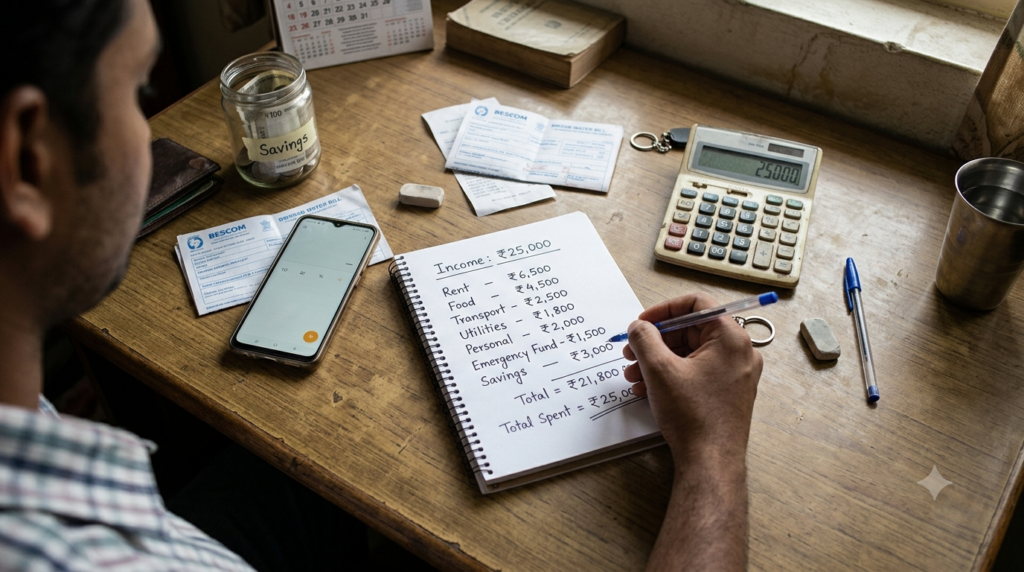
7. Give Every Saving Goal a Name
Saving money simply because “I should save” is vague.
Specific financial goals are easier to understand and measure.
Instead of saying:
“I want to save more money.”
Try:
“I want to build my first ₹30,000 emergency fund.”
Or:
“I want to save ₹20,000 for a professional course.”
Your savings goals could include:
Emergency fund
Education
Professional certification
Vehicle purchase
Wedding expenses
Travel
Home deposit
Retirement
Debt repayment
Once your savings have a purpose, every contribution feels connected to something meaningful.

Sample ₹25,000 Salary Saving Plan
Here’s a simple alternative way to structure your salary.
MONTHLY SALARY — ₹25,000
Essential Expenses — ₹17,000
Savings / Emergency Fund — ₹4,000
Personal Wants — ₹2,000
Monthly Buffer — ₹2,000
TOTAL — ₹25,000
If the ₹2,000 buffer isn’t required during a particular month, you could transfer some or all of the unused amount to savings.
Saving ₹4,000 every month would mean:
₹4,000 × 12 = ₹48,000
That’s ₹48,000 in contributions over one year.
However, ₹4,000 isn’t a compulsory target.
If you can currently save only ₹1,500, start there.
If your living arrangements allow you to save ₹6,000 or ₹7,000, that’s also fine.
The right savings target is one that works with your real financial situation.
Should You Save or Invest First?
Saving and investing have different purposes.
Money you might need for emergencies should generally remain appropriately accessible.
Money intended for long-term goals may potentially be invested according to your goals, time horizon, financial circumstances and risk tolerance.
A practical order for someone beginning with a ₹25,000 salary may look like:
BUDGET
↓
EMERGENCY SAVINGS
↓
MANAGE EXPENSIVE DEBT
↓
LONG-TERM SAVINGS AND INVESTING
Your circumstances may require a different order.
The important point is not to put money required for next month’s essential expenses at unnecessary investment risk.
[INTERNAL LINK: Saving vs Investing for Beginners in India]
Common Mistakes When Saving on a ₹25,000 Salary
Trying to Save Too Much Immediately
Don’t create an unrealistic savings target simply because it looks impressive.
If saving ₹8,000 means you need to withdraw ₹5,000 again before payday, the plan isn’t working.
Start with a sustainable target.
Ignoring Irregular Expenses
Not every expense happens monthly.
You may occasionally need money for:
Festivals
Clothing
Vehicle servicing
Annual insurance premiums
Family events
Travel
Repairs
Create a small monthly provision for predictable irregular expenses.
Using Credit for Lifestyle Purchases
Using debt for unnecessary lifestyle spending can reduce the amount of future salary available for savings.
Before borrowing for a non-essential purchase, consider whether waiting and saving for it is possible.
Mixing Emergency Savings With Spending Money
When all your money sits together, it’s easy to spend money that was supposed to remain untouched.
Consider keeping emergency savings separate from your normal spending balance while maintaining suitable accessibility.
Not Tracking Expenses
Creating a budget once isn’t enough.
Compare your actual expenses with the amount you planned.
If your food budget was ₹4,000 but you consistently spend ₹6,000, investigate why.
Either your target is unrealistic or your spending needs adjustment.
What If Your Expenses Are Already Too High?
Sometimes the problem isn’t a lack of discipline.
The mathematics simply doesn’t work.
Suppose your essential expenses already consume almost your entire ₹25,000 salary.
Cutting ₹100 from entertainment isn’t going to transform your financial situation.
You then have two broad options:
REDUCE A MAJOR EXPENSE
or
INCREASE YOUR INCOME
Look carefully at large fixed costs such as housing and transportation first.
If these cannot realistically be reduced, improving your income may eventually become more important.
Depending on your skills and circumstances, options might include:
Overtime
Freelance work
Tutoring
Weekend work
Skill development
Professional certification
Applying for better-paying roles
However, be cautious about schemes that require large upfront payments or promise unrealistic earnings.
A Simple Payday Routine for a ₹25,000 Salary
Create a repeatable routine every time your salary arrives.
STEP 1 — Transfer your planned savings.
STEP 2 — Pay essential fixed bills.
STEP 3 — Set aside grocery money.
STEP 4 — Set aside transportation money.
STEP 5 — Allocate your personal-spending budget.
STEP 6 — Keep a small monthly buffer.
STEP 7 — Review expenses once a week.
You don’t need to think about your entire financial life every day.
You need a system that makes good decisions easier to repeat.
How Much Can You Save From a ₹25,000 Salary?
There is no universal answer.
Here are simple examples:
₹1,000/month = ₹12,000/year
₹2,000/month = ₹24,000/year
₹3,000/month = ₹36,000/year
₹4,000/month = ₹48,000/year
₹5,000/month = ₹60,000/year
These figures simply multiply the monthly contribution by 12.
They don’t include investment returns, interest or withdrawals.
Don’t compare your savings amount with someone whose financial responsibilities are completely different.
Someone living with parents and paying no rent may be able to save far more than someone supporting a family.
Consistency matters more than comparison.
How to Increase Your Savings Over Time
You don’t need to remain at the same savings amount forever.
Suppose you begin by saving ₹2,000 per month.
After a few months, you reduce unnecessary spending and increase it to ₹2,500.
Later, your salary increases and you raise it to ₹3,500.
This gradual approach can be easier to sustain.
Think of saving as a financial habit that grows with your income.
Whenever you receive:
A salary increase
Bonus
Freelance income
Incentive
Unexpected extra income
consider directing at least part of it toward your financial goals.
Final Takeaway
Learning how to save money on 25000 salary isn’t about finding one magical budgeting percentage.
It’s about creating a system you can repeat every month.
Start by understanding where your ₹25,000 goes.
Create a realistic budget.
Transfer savings shortly after payday.
Control your biggest expenses.
Separate needs from wants.
Build an emergency fund gradually.
Avoid unnecessary lifestyle debt.
And increase your savings whenever your income improves.
You don’t have to transform your finances in one month.
If you consistently make your financial position slightly stronger every month, those small improvements can become meaningful over time.
Frequently Asked Questions
Is it possible to save money with a ₹25,000 salary?
Yes. The amount you can realistically save depends on rent, transportation, debt, family responsibilities and other essential expenses. Start with an amount you can consistently maintain.
How much should I save from a ₹25,000 salary?
There is no universal amount. For illustration, ₹2,500 is 10% of ₹25,000 and ₹5,000 is 20%. Your actual savings target should depend on your essential expenses and financial obligations.
Can I save ₹5,000 every month from a ₹25,000 salary?
Potentially, yes, if your essential and discretionary expenses can fit within the remaining ₹20,000. If saving ₹5,000 repeatedly forces you to borrow money before payday, choose a lower and more sustainable target.
What is the easiest way to start saving from salary?
Choose a realistic savings amount and move it into a separate savings balance shortly after receiving your salary. Then manage your monthly expenses using the remaining money.
Should I invest if my salary is ₹25,000?
Your decision should depend on your financial situation, goals, risk tolerance and time horizon. Building an appropriate emergency fund and controlling expensive debt can be important priorities before committing money needed for near-term expenses to investments.
How big should my emergency fund be?
A commonly used longer-term goal is several months of essential living expenses. You don’t need to build it immediately. Start with a smaller milestone such as ₹5,000 or ₹10,000 and gradually increase it.